I enjoyed myself at the Singapore Writers Festival 2025!
Here are some pictures from my day at The Arts House at The Old Parliament.
The Arts House at the Old Parliament, during the Singapore Writers Festival 2025! Photograph by author Shawn Seah. Author and speaker Shawn Seah at the Singapore Writers Festival 2025. Photograph by Shawn’s team. Behind the scenes: Brenda Yeoh, Shawn Seah, and Wesley Aroozoo getting ready for our Singapore Writers Festival 2025 panel. This photograph also reminds us of an age-old question: how many degree holders does it take to set up a laptop? Photograph by Shawn’s team.
As a history enthusiast, I am always excited to share about my family history, including my children’s non-fiction series Our Amazing Pioneers, which features many Singapore pioneers who have streets named after them, like Seah Eu Chin (Eu Chin Street), Seah Liang Seah (Liang Seah Street), and Tan Seng Poh (Seng Poh Road, Seng Poh Lane).
While admittedly it might sound somewhat self-indulgent, I felt pride and joy when I spoke to a full house of 75 attendees who packed the Screening Room at the Arts House, to listen to me talk about my family history books and my research!
On this exciting occasion, I was delighted and honoured to have distinguished Professors Victor Savage and Brenda Yeoh as my fellow panellists.
I found Victor to be a history and heritage buff, full of knowledge about Singapore’s history, which was unsurprising, but, above all, I personally found Brenda very kind, encouraging, and supportive.
(For example, during the panel discussion, Brenda helped to click through Victor’s slides, because he had so many of them, and somehow she got most of the order right! She was also so charming and friendly towards me.)
From left to right, Wesley Leon Aroozoo, Brenda Yeoh, Shawn Seah, and Victor Savage. Photograph by Shawn’s team.
Back when I was writing Seah Eu Chin: His Life and Times(first edition in 2017), I actually cited Savage and Yeoh’s books: Toponymics: A Study of Singapore Street Names and Singapore Street Names: A Study of Toponymics.
Their books on toponymics (the study of place names) provided a starting point for me to explore Singapore’s history through street names.
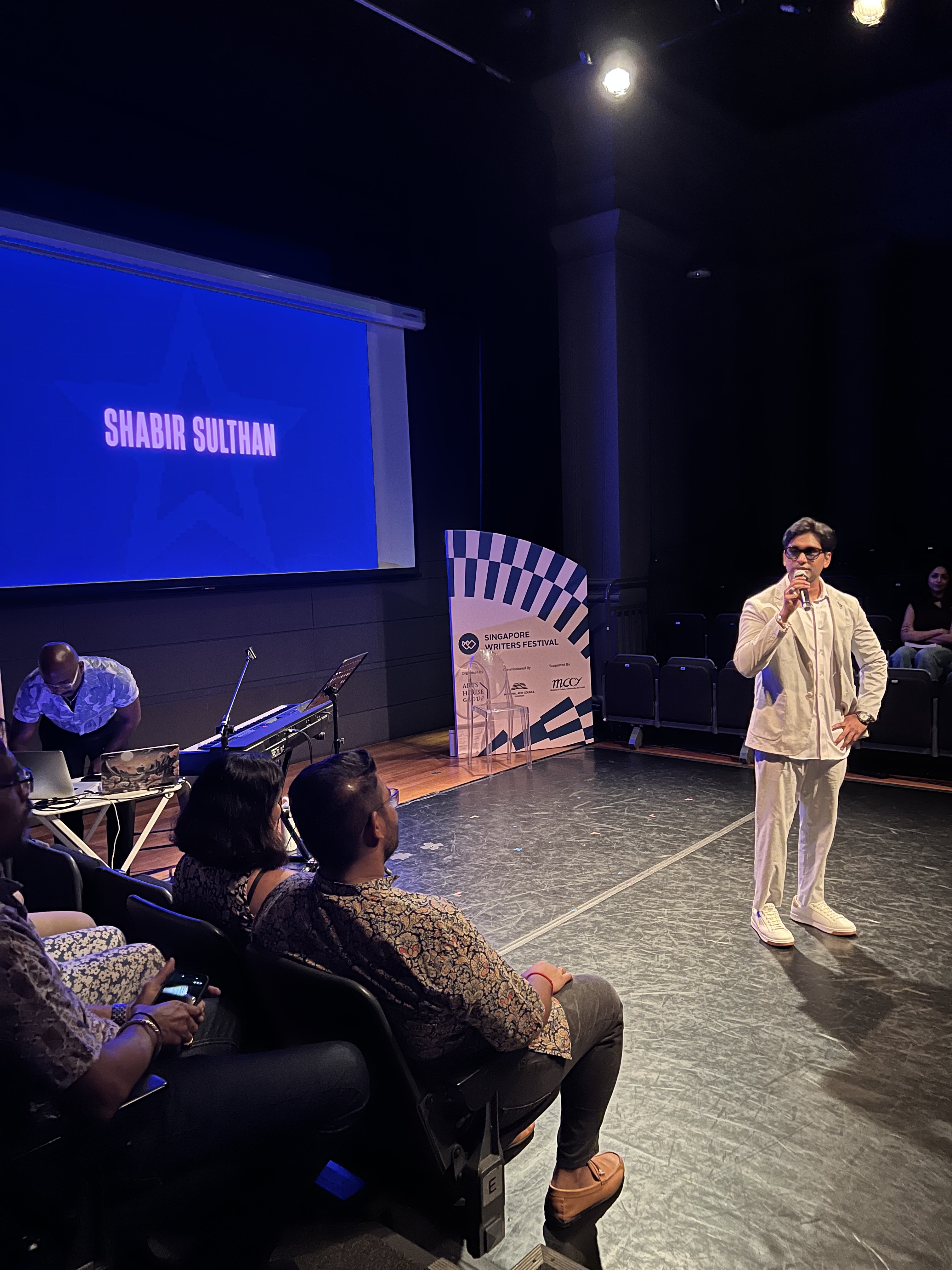
Other than my own panel discussion, I sat in for Shabir Sulthan’s performance lecture. I also enjoyed his session and learnt a lot, for example, of the importance of going regional or international as a content creator (he is big in India).
Shabir Sulthan performing and lecturing at the Singapore Writers Festival 2025. Photograph by author Shawn Seah.
Briefly, Shabir is a Singaporean composer and singer. Among his many musical achievements, he was one of the main singers for the 2021 National Day Parade (NDP) theme song, “The Road Ahead”. (Anyone who knows me know that I genuinely enjoy NDP songs.)
Through his stories and musical examples, like his composition of “Singai Naadu” (translated: “Singapore, my country”), he showed how melodies can be multicultural, carry our memories, and help us recognise the feelings we share as a people.
He shared that there was a sentiment in Singapore’s Indian community back in 2012: “Why was Munnaeru Vaalibaa the only Tamil NDP song?”
Shabir realised that older English-language NDP songs were of a certain style, generally upbeat and more action-oriented, aimed at building a new nation, and another common perception was that Indian songs had to come with the tabla and the sitar. However, he thought that Indian culture had so much more to offer.
He wanted to go for a more sentimental and emotional approach that went beyond traditional Indian music.
Although his song was not ready in time to be considered for the 2012 NDP, it was still played during the pre-parade segment, and also came to then-Prime Minister Mr Lee Hsien Loong’s attention that year.
Listening to Shabir’s perspectives (and his singing) not only opened my mind to different perspectives; it gave me an enjoyable experience at the Singapore Writers Festival.
Street names help us remember the amazing pioneers who built Singapore, while songs composed by Singaporeans like Shabir help us feel our connection to one another. Both are part of the larger Singapore Story and shape how we see our past and our future, “with hope, courage, and imagination”.
Thank you for reading!
Cheers, Shawn Seah
About the Author
Shawn Seah is a published author and public speaker who makes Singapore’s history come alive through engaging storytelling. He is the author of the children’s non-fiction series Our Amazing Pioneers and Our Amazing Heroes, and speaks regularly about family history, Singapore Stories, and the art of storytelling at schools, literary festivals, and museums.
Starting your journey to become an author is both exciting and challenging. However, the journey is also full of challenges. I have made so many mistakes in writing, editing, self-publishing, and mainstream publishing. But I have also learnt from them.
Here are some key lessons and reflections every aspiring author should know before starting on their writing or publishing journey.
I hope my lessons and reflections (from hard experience) will be useful to you.
No one can actually guarantee a smooth journey, but if you are reading this, at least you can be properly informed before you make any decisions.
“Our Amazing Pioneers” series of books on pioneers like Seah Eu Chin, Tan Tock Seng, and Syed Omar Aljunied. Photograph by writer’s team.
First, don’t expect to make a fortune
Don’t be too quick to quit your day job once you start writing.
There are millions of books published each year (both through mainstream and self-publishing routes). In fact, most books do not sell more than a few hundred copies.
What this means is that statistically speaking, not every book you publish will be a bestseller (if you even publish a bestseller at all).
Not every book idea is going to be sheer genius.
As a result, the harsh reality is that few authors make significant money from their books.
Even if there is money to be made, it will not come from the books themselves, but from other sources, like additional programmes you deliver.
Trust me, I hate to be the one to tell you this hard truth, especially since I love writing, but I think it’s important to be realistic about the financial aspects.
If you don’t expect to make a fortune, and you eventually do, you will be pleasantly surprised.
Second, aim to be a professional
Treat your writing seriously, setting aside dedicated time and striving for high-quality work.
Yes, inspiration is important, but so is perspiration.
Writing is a skill that needs dedicated, committed, continuous practice.
Keep writing, reading, and learning.
Even the best writers keep improving upon their craft.
Third, be prepared to polish relentlessly
No one creates a perfect masterpiece on their first try (or even their seventh try; trust me).
Be prepared to edit your work many, many times. Edit your writing, take breaks, and come back with fresh eyes, and have an editor review it.
(An editor can help you with many aspects beyond copyediting and proofreading; an editor is more than someone who just fixes typos, spelling errors, and grammatical mistakes. However, at the end of the day, you still have to be able to edit your own writing.)
Polish your writing: remove redundancies; tighten up; keep sentences and paragraphs readable; correct spelling mistakes and typos; and check facts and figures. Relentless editing is crucial for creating a polished final product.
But I have to confess: no matter how hard you scrub, one or two mistakes will always get through. Pay special attention to figures: dates, numbers, financials. Despite my economics training, sometimes figures get mixed up.
Live and learn, as I always say. Be prepared to forgive yourself over and over again.
Fourth, understand yourself and your unique perspective
Ask yourself what makes you uniquely qualified to write this particular book. Why you?
Consider your personal experiences, educational qualifications, or background that make you the right person to write this book.
Your unique perspective is what will set your book apart from others’ books.
Fifth, distinguish your book(s) from comparable titles
On the one hand, your book needs to be similar enough to existing titles so that publishers know there is a market or existing demand for it.
On the other hand, it cannot be too similar, as it needs to stand out from the crowd, being a bit differentiated.
Think about what unique angle, data, or insight you can offer that others haven’t, and make sure this is clear in your book or book series.
Sixth, have a regular, consistent writing schedule
One of the biggest challenges facing any writer is maintaining a regular writing schedule.
Waiting for the “perfect moment to write” or for “inspiration to strike” often leads to procrastination.
Yes, it sounds a bit like work, but being professional means treating writing as work: hard work! As Denzel Washington rightly said, “Hard work works.”
Set up a routine that works for you.
Set achievable goals, like writing a certain number of words each day or week.
I often set myself modest goals, like “at least one sentence per night” or “at least one paragraph on weekend nights”.
Seventh, criticism will come. Deal with it
I think the biggest shock I received was how some people can be incredibly rude and unkind, but I have learnt to deal with it over the years.
(BUT I immediately hasten to add that the vast majority of readers I have come in contact with are kind, encouraging, and supportive people.)
Rude rats are real. I personally have been called “sh*t” in Hokkien; falsely accused of stealing other people’s ideas (they were not published, but I was); and heckled at book talks.
Sometimes, the funniest part of these criticisms is that the person has not even read the books in question and is just making unjustified ad hominem attacks.
Par for the course: criticism is an inevitable part of the writing journey.
Not everyone will love your work, and that’s OK.
Develop a thick skin and learn to deal with criticism constructively.
Where relevant, use criticism or constructive feedback to improve your writing, rather than being discouraged.
However, if it is irrelevant criticism or unconstructive feedback, then ignore the naysayers.
Remember, even the most successful authors face criticism. When you put yourself out there, there will be the occasional rude and unkind person. Learn to forgive them and yourself.
Eighth, understand the publishing landscape: traditional, mainstream publishing vs. self-publishing
The publishing industry offers several ways to bring your work to readers.
Traditional publishing provides credibility, editorial support, and marketing and distribution resources.
Self-publishing offers control and potentially higher royalties, and gives you the opportunity to handle everything from editing to marketing.
Ninth, build or strengthen your platform
Build an author platform to reach audiences and engage with readers. If you have an existing one, continue to strengthen it.
What is a platform? It is essentially like “street cred”, credibility, or expertise; existing popularity; and connection with your readership. How do you reach out to readers? How do your readers reach out to you? And how big is your support group, your fan base, your community?
Use social media, create a professional website, or start a blog to share your journey and connect with your audience.
Network with other writers, participate in literary events, and connect with many people.
For example, when I first started along my writing journey, it was difficult to reach out to readers in the beginning. I had to build my mailing list one email at a time, and network with people and make connections, one person at a time. Slowly, but surely, over many public talks, I have gradually built up and strengthened my platform.
Today, things are much easier now that I have a mailing list of kind people who are supportive of my writing. And I still keep growing my influence and community, bit by bit.
Build your platform.
Tenth, stay resilient: don’t give up
In any major undertaking, you will face challenges. That’s normal.
Rejection is an inevitable part of the writing journey. That’s normal too.
Feeling alone in the writing journey and wanting to give up is also normal.
And like I mentioned earlier, there will be all sorts of critics (you can count on it).
Not every publisher will be interested in your manuscript; not every editor will love your book proposal; and not every reader will love your work.
My word of advice: don’t give up.
Keep learning, growing, and writing.
Really, don’t give up easily
Keep your passion alive.
Write stories that matter to you.
Remember why you started writing in the first place and let passion drive you forward. But temper your passion with hard truths and realistic expectations.
The journey to becoming an author is filled with ups and downs, moments of self-doubt, and triumphs. But you can get better and better over time.
After reading about my personal experiences and lessons, at least you are better prepared to go on your own journey and experiences.
All the best and keep writing! May you contribute to positive change in the world, even if it is in your own, small way.
Thank you for reading.
Cheers, Shawn Seah
(The original story was first posted on my Medium blog on 1 June 2024. This story was reposted here and updated on 2 June 2024.)
Baby Sarah appears to be “doing research”. Photograph by writer.
Genealogy, or family history, can be thought of as the study of a family’s origins, history, or stories. It was often used by royalty and nobility to showcase their lineage. Descent from ancient kings, queens, chieftains, religious leaders, or warriors conferred pedigree, prestige, and power that allowed the descendant to command authority and respect.
But this area of study is also an everyday hobby or pastime where people (like you and me) can search for their roots and learn about parents, grandparents, and great-grandparents. Through these personal stories, enthusiasts can learn about culture, community, and country. And for these reasons, I personally prefer the more intimate-sounding term “family history” to “genealogy”, even as the two terms are often used interchangeably.
To me, family history helps us discover where we come from, who we are, and what values and traditions we held or hold. While many start searching for their roots only when they have retired, one can actually start earlier, as I did, in my early thirties. I have even met people in their twenties who are interested in understanding their families better.
A Popular Pursuit
Family history is an extremely popular hobby among enthusiasts worldwide.
In a 2012 article titled “Who’s Your Daddy? Genealogy Becomes $1.6B Hobby”, ABC News reported that then-CEO of Ancestry, Tim Sullivan, said that genealogy was no longer “a niche” and there was a “broad, mainstream interest in family history”.
A 2014 Time article ran a provocative headline, “How Genealogy Became Almost as Popular as P***”.
And a 2022 New Yorker article even labelled it an “obsession”.
Singaporeans are also deeply interested in family history. A range of public examples proves that this is the case.
In September 2023, The Straits Times reported that Genealogy Society Singapore published 12 Family Histories – A Tapestry Of Singapore’s Multicultural Legacy, bringing to life stories of 12 migrant families of Arab, Bugis, Chinese, Eurasian, Indian, and Peranakan descent who called Singapore home.
In December 2022, The Straits Times reported that the 12th edition of the Pang Family (Singapore) Genealogy Book included, for the first time, women in their latest edition, which had an additional aim of encouraging more families to trace and document their histories.
In October 2022, The Straits Times reported that retired florist Bernard Chiang took 17 years to research his family history, spanning multiple countries and cultures, in The Chiang Family History — A Tale Of Three Cultures And Chia Keng Village.
In June 2022, The Straits Times reported that An Illustrious Heritage: The History Of Tan Tock Seng And Family (a book by Kua Bak Lim, Lim How Seng, and Roney Tan) revealed new details of Hokkien philanthropist Tan Tock Seng and his clan.
In 2020, Samuel Wee self-published his family history, An Exhibition of Ages: Becoming Straits Chinese.
And during the Singapore Bicentennial in 2019, many family history books were published, including Cyprian Lim’s My Maternal Roots: a Story of Family, Faith and Freedom; Vivienne Tan’s Tan Kim Seng: A Biography; Linda Kow, Ruth Chia, and Soh Tiang Keng’s Chia Ann Siang and Family: The Tides of Fortune; and my book, Leader and Legislator: Seah Liang Seah. Earlier, I also launched my first self-published book, Seah Eu Chin: His Life & Times in 2017.
However, family history is not regarded a proper academic discipline.
Many still consider it a hobby or, more charitably, a developing academic area.
While family history has historical elements, focus tends to be on individuals or families.
Some family historians have the tendency to be concerned with minutiae or relatively obscure topics, rather than broader historical themes or the sweep of the longue durée.
And family history is often perceived to be driven by motivated, passionate, and interested individuals or families with vested interests, rather than driven by dispassionate, objective, and rational researchers.
How to Get Started
The truth is that, like many, I am just a history enthusiast. Or if you prefer the National University of Singapore’s label of what I do, I’m a “historical storyteller“.
Whatever one might call me, I’m definitely not a professional genealogist or professional family historian.
However, having spent many years exploring my family history and family tree; having published several books on my family history; and having spent a lot of time with likeminded individuals, I have some unique insights and perspectives that will help those who would like to get started.
And these insights and perspectives are accessible, simple, and direct for normal people like you and me, who might not be academics, professionals, or high-level experts. In fact, I wrote and published my family history books while holding down a full-time job and pursuing this area as a heritage hobby.
In this article, I have compiled and sketched out some general steps, tips, and techniques for you to help you get started on your journey in searching for your roots.
The very first step itself might surprise you.
Start by Setting Goals
Setting goals is crucial.
Decide on your goals before you start and adjust your course along your journey.
Is this search a pastime, hobby, passion, calling, vocation, career, or legacy? Is this research for homework, schoolwork, a Master’s degree, PhD programme, or academic paper? Do you have a research grant or funding support for your efforts, or is this going to be self-funded? How much funding do you have for this project or projects?
And if you are funded, who is the grantor, what are their interests and priorities, what are the milestones and deliverables, if any, and how much is the funding or co-funding?
Who are the people with you on your journey? Who would you network with and cooperate with to share data and activities? Are you a member of any associations, clans, or churches?
Are you doing both research and writing? Or are you hiring a professional genealogist to help you with the research while you focus on the writing? Or are you hiring a professional ghostwriter?
Are you writing a story based on the life of your favourite relative or direct ancestor, or several family members, or your entire clan or community (for example, a one-person biography would be different from a many-person biography)? Are you setting up a website or blog?
What are you writing? Is it a nonfiction book? Or is it something less formal like a family tree poster, a scrapbook, or a newsletter? Is it a record of your experiences and discoveries? How would your writing be organised? Would it be organised chronologically, by family branch, or by historical theme? What method of academic citation will you use to document sources of information?
You should pace yourself as a family history project might take a long time — and might never end. Remember that retired florist Bernard Chiang took 17 years to research his family history.
Reevaluate and adjust your goals and objectives as you progress in your journey.
Interview Your Family
Your family is the natural starting point for foundational research. Start with your immediate family, beginning with who and what you know to be true, and build on from there towards the unknown. You can expand the search to extended family members later.
When I first started, I spoke with my father and one of my aunts who was essentially our “family historian”. I learnt from them. Even when they did not know, they were able to point me to useful resources or give me leads to follow up on.
In general, most people also begin similarly by interviewing family members and consulting family records, marriage certificates, death certificates, photos, diaries, and letters, as a starting point to gather information.
In fact, interviewing relatives is enjoyable. People enjoy sharing about topics close to their hearts. The key is to transform pleasant afternoon conversations into solid foundations for future detective work.
Remember to capture relatives’ memories before they pass away. Ask many questions; record or videotape answers if possible. If they can write or type, try to obtain their recollections and thoughts in writing. (Personally, I find that I greatly prefer capturing information in writing, and asking them to directly make edits or corrections in writing, so that there is a written record for me to refer to.)
Preserve originals or copies of all photographs and documents they share with you. Identify people pictured in photographs while living relatives can still identify them.
Visit the Library
Tap into the wealth of library materials. In libraries hide genealogies and family trees; histories of communities, cities, and countries; and maps which ground events in the physical world. You can access books, journals, magazines, newsletters, archival material, oral histories, and e-resources.
Personally, I find Singapore’s National Library Board’s e-resource, NewspaperSG, useful for family history research. Old newspapers have a wealth of information in the obituaries section. From death notices, you could pick up information like the full name of the deceased; their religion; names of spouses and children; and maybe names of their grandchildren.
And in the past, when prominent pioneers passed away, their passing would be reported in the newspapers. The descriptions of the funeral procession and names of those who attended could help augment information found in obituaries.
Beyond conducting family history research, going to the library also allows one to learn about the historical, political, economic, and social context of the time. Books on history, politics, economic history, and sociology can shed light on what you have found. Sources should be examined in light of historical events. And one can also use historical content to transform seemingly-boring facts into engaging life stories.
Take for example, my grandparents’ marriage certificate.
When I first looked at the date to find out when they were married, the year staring back at me was “2604“. They were also married in “Syonan-To”. One might reasonably ask: how could they have been married in the year 2604 in Syonan-To?
This is why history matters. When the Japanese occupied Singapore, they renamed the island “Syonan-To” (Light of the South). They also used their Imperial calendar, which was different from the calendar we are familiar with.
Incidentally, many history buffs and Singaporean students are familiar with the Japanese fighter aircraft, the Zero. During the Second World War, this aircraft was used in military operations. One might wonder: why was it known as the Zero?
It was known as the Zero because the year its production began, 1940, was the Imperial year 2600, hence its designation.
With some basic historical knowledge, we can deduce that my grandparents were married in Singapore (“Syonan-To”), in 1944 (“2604”).
Visit Places
You could also make trips to places rich with sources, such as archives, clan associations, or churches. Some enthusiastic people even travel overseas to places their ancestors originally came from to look for sources and meet members of their extended family.
For example, among people in clan associations, it is common to hear of people either wanting to go back to China to visit their ancestral villages or actually having been back there. (I find it fascinating when they share about their experiences and what they have learnt from the visit, even though I personally do not have such an urge to travel back.)
In Chinese clan associations, there are often jiapu and zupu (family or genealogical records), which can help in reconstructing one’s family tree. However, this is a science in itself, because only those with technical knowledge can read a Chinese family tree and decode the characters and system.
Using church records (parish registers) as another example, the recording of civil status data in records of churches started as early as the 16th century. Old church records can today be found in parish archives and some old registers have been recorded on microfilm.
Use Tech and Work on Digitisation
Today, the range and scope of tech has expanded.
Software, online tools, and other tech today can help with building family trees, conducting DNA testing, or compiling genealogical information. Many of my fans and supporters do use such platforms and occasionally tell me about them, like Geni.com.
However, as I have no direct, personal experiences with using such tools, others would be better placed to explain how best to use these tech tools.
But when it comes to digitisation, I have much experience in this.
Digitisation means to transform a physical medium into a digital one, including scanning documents or taking photographs.
I personally find it satisfying and therapeutic when I scan documents using my printer. And I am lucky to have a small team of volunteers who can utilise technologies like OCR (Optical Character Recognition) to convert images to text.
There are good reasons for me to digitise information. This is because documents, photographs, and other physical items are “perishable”. They need special care, tech, and expertise to be properly cared for and preserved. And despite one’s best efforts at preservation, mistakes can happen and precious artefacts can be damaged or destroyed.
Digitisation helps you access sources safely in the future. Some best practices include keeping storage media up-to-date and creating multiple backups of digital data. Sometimes, I even send myself an email (and I also archive my emails).
I would strongly recommend digitisation to anyone doing research into their family history.
Don’t Believe Everything
It is important to be a critical thinker and watch out for our cognitive biases.
Family history today does depend heavily on Internet sources, including records and sources found online. But do watch out for “fake news” on the internet. Not all online sources are reliable and distinguishing between reliable and unreliable sources is more art than science.
Online falsehoods spread faster and go viral more quickly than facts, accurate figures, and truths.
But more challenging than “fake news” or DRUMS (distortions, rumours, untruths, misinformation, smears) on the Internet are actual secrets that families have tried to keep hidden. There are issues of silences and omissions, and family members changing and altering records and family stories to serve their own interests. Errors are one thing, but deliberately falsifying or changing information can pose problems.
For example, in Chinese jiapu and zupu, it was not uncommon for families to strike members of the family off the record if they became criminals or were unfilial. In fact, they could be struck off for any personal reason whatsoever that led to the family or clan “losing face”. It was also not uncommon for people to change their names; take on different surnames; or amend the records.
(Personally, I know people who changed their names through a deed poll or resorted to a different name after a past situation.)
These days, it is also not uncommon that, after DNA testing, people find out that their parents are unrelated to them because they were adopted or their parents were their uncles or aunts.
All these mean that the savvy researcher must strike a delicate balance, deciding between fifty shades of truths. And upon finding out the truth, or perspectives on the truth, the savvy researcher needs to be able to sensitively, diplomatically, and sensibly handle such information. Interesting, but not easy.
Bring in the Professionals
You may also wish to pay a professional genealogist or an expert to undertake research.
Even though there are many free resources on the Internet (including articles I have written) dedicated to family history research or writing on one’s family, many family historians recognise the value of having a professional assist in the search.
Or alternatively, you might want to develop your skills to a high level, such that you become a professional genealogist instead.
I imagine professionals have a rewarding and meaningful job. Essentially, they are paid to research, build family trees, and help find long-lost relatives. In other words, a genealogist is like a history detective solving family mysteries. Currently, no formal qualifications are necessary, but many have a history degree, or a library or archive-related qualification. Experience in dealing with a wide range of sources is necessary.
Let Your Intuition Guide You
No one expects a smooth journey when it comes to family history.
Sometimes the sources are not there. Sometimes they are there, but you have not found them yet.
If you hit roadblocks, sometimes what you need is to let your intuition guide you. Let your interests, current findings, and experiences guide your journey. Constantly re-adjust your course in light of new findings or leads.
Maintain your faith in your search. Something big might turn up, sooner or later. It might just be round the corner. Take a deep breath and carry on.
Conclusion
To recap the broad key points to help you start your family history journey:
(1) Set your goals and objectives;
(2) interview your family and collate photographs, documents, and other artefacts;
(3) visit the library to learn history and view sources;
(4) visit other places rich in sources, like archives, clan associations, or churches;
(5) digitise what you have found and tap into online resources while
(6) discerning between fact and fiction(s);
(7) consider bringing in professional genealogists if necessary; and
(8) trust your intuition to get you through tough times.
Like me, I am sure you will find your search interesting and meaningful.
Our family history helps us learn where we come from, who we are, and what values could anchor and guide us to keep moving forward. By knowing where we come from, and who we are, we have a good chance of remaining rooted and centred in an ever-changing world. I wish you all the best for your search and journey.




 Shawn Seah Li Song
You must be logged in to post a comment.