I enjoyed myself at the Singapore Writers Festival 2025!
Here are some pictures from my day at The Arts House at The Old Parliament.
The Arts House at the Old Parliament, during the Singapore Writers Festival 2025! Photograph by author Shawn Seah. Author and speaker Shawn Seah at the Singapore Writers Festival 2025. Photograph by Shawn’s team. Behind the scenes: Brenda Yeoh, Shawn Seah, and Wesley Aroozoo getting ready for our Singapore Writers Festival 2025 panel. This photograph also reminds us of an age-old question: how many degree holders does it take to set up a laptop? Photograph by Shawn’s team.
As a history enthusiast, I am always excited to share about my family history, including my children’s non-fiction series Our Amazing Pioneers, which features many Singapore pioneers who have streets named after them, like Seah Eu Chin (Eu Chin Street), Seah Liang Seah (Liang Seah Street), and Tan Seng Poh (Seng Poh Road, Seng Poh Lane).
While admittedly it might sound somewhat self-indulgent, I felt pride and joy when I spoke to a full house of 75 attendees who packed the Screening Room at the Arts House, to listen to me talk about my family history books and my research!
On this exciting occasion, I was delighted and honoured to have distinguished Professors Victor Savage and Brenda Yeoh as my fellow panellists.
I found Victor to be a history and heritage buff, full of knowledge about Singapore’s history, which was unsurprising, but, above all, I personally found Brenda very kind, encouraging, and supportive.
(For example, during the panel discussion, Brenda helped to click through Victor’s slides, because he had so many of them, and somehow she got most of the order right! She was also so charming and friendly towards me.)
From left to right, Wesley Leon Aroozoo, Brenda Yeoh, Shawn Seah, and Victor Savage. Photograph by Shawn’s team.
Back when I was writing Seah Eu Chin: His Life and Times(first edition in 2017), I actually cited Savage and Yeoh’s books: Toponymics: A Study of Singapore Street Names and Singapore Street Names: A Study of Toponymics.
Their books on toponymics (the study of place names) provided a starting point for me to explore Singapore’s history through street names.
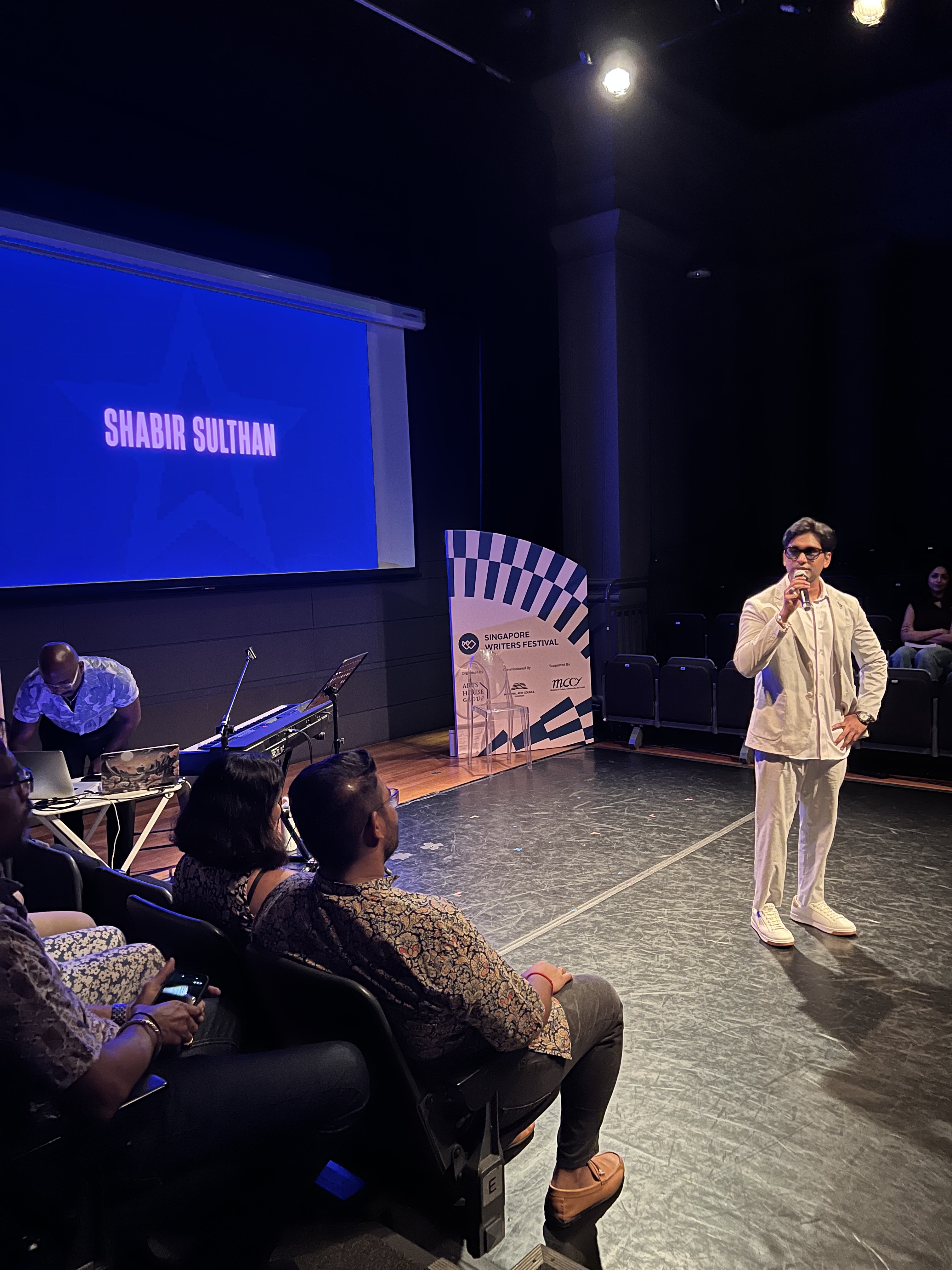
Other than my own panel discussion, I sat in for Shabir Sulthan’s performance lecture. I also enjoyed his session and learnt a lot, for example, of the importance of going regional or international as a content creator (he is big in India).
Shabir Sulthan performing and lecturing at the Singapore Writers Festival 2025. Photograph by author Shawn Seah.
Briefly, Shabir is a Singaporean composer and singer. Among his many musical achievements, he was one of the main singers for the 2021 National Day Parade (NDP) theme song, “The Road Ahead”. (Anyone who knows me know that I genuinely enjoy NDP songs.)
Through his stories and musical examples, like his composition of “Singai Naadu” (translated: “Singapore, my country”), he showed how melodies can be multicultural, carry our memories, and help us recognise the feelings we share as a people.
He shared that there was a sentiment in Singapore’s Indian community back in 2012: “Why was Munnaeru Vaalibaa the only Tamil NDP song?”
Shabir realised that older English-language NDP songs were of a certain style, generally upbeat and more action-oriented, aimed at building a new nation, and another common perception was that Indian songs had to come with the tabla and the sitar. However, he thought that Indian culture had so much more to offer.
He wanted to go for a more sentimental and emotional approach that went beyond traditional Indian music.
Although his song was not ready in time to be considered for the 2012 NDP, it was still played during the pre-parade segment, and also came to then-Prime Minister Mr Lee Hsien Loong’s attention that year.
Listening to Shabir’s perspectives (and his singing) not only opened my mind to different perspectives; it gave me an enjoyable experience at the Singapore Writers Festival.
Street names help us remember the amazing pioneers who built Singapore, while songs composed by Singaporeans like Shabir help us feel our connection to one another. Both are part of the larger Singapore Story and shape how we see our past and our future, “with hope, courage, and imagination”.
Thank you for reading!
Cheers, Shawn Seah
About the Author
Shawn Seah is a published author and public speaker who makes Singapore’s history come alive through engaging storytelling. He is the author of the children’s non-fiction series Our Amazing Pioneers and Our Amazing Heroes, and speaks regularly about family history, Singapore Stories, and the art of storytelling at schools, literary festivals, and museums.
School assemblies are an important part of pupils’ lives.
They are a shared community experience where the whole school comes together, to start the day or mark a special occasion, like 60 years of Singapore’s independence (SG60) or a school’s anniversary.
Author Shawn Seah speaking at Ngee Ann Primary School during an assembly talk. Photograph by Shawn’s team.
Speaking at a school assembly is an honour and a privilege.
You are responsible for engaging the entire school as well as teachers who are standing or sitting by the side of the school hall.
The heads of department, teachers, or librarians who invited you have entrusted you with this (sacred) duty.
All eyes are on you, and for that 20, 25, or even 30 minutes, you hold court.
A school assembly talk should be energetic, engaging, and exciting for the children. Or, as I like to put it, “edu-taining”.
When done well, a talk can stay with children long after the bell rings.
Here are some of my personal reflections and best practices, drawn from my experiences and mistakes of speaking to children aged seven to twelve at school assemblies across Singapore. They remind me of what worked well, and hopefully you might find some of these pointers useful too.
Author and speaker Shawn Seah introducing his children’s book series, Our Amazing Heroes. Photograph by Shawn’s team.
Have a lot of positive energy!
You have to begin with a lot of energy and a positive attitude to engage the students!
Come in with good posture, a bright presence, and a can-do spirit.
Let your enthusiasm show from the moment you step onto the stage.
Smile widely and think happy thoughts!
A big wide smile shows that you are friendly, confident, and approachable. It sets the tone.
Best of all, smiles are contagious. If you smile, they smile back.
I am often reminded of what Dale Carnegie once wrote about magician Howard Thurston in How to Win Friends and Influence People.
Each time Thurston went up on stage to perform, he said to himself: “I am grateful because these people come to see me. They make it possible for me to make my living in a very agreeable way. I’m going to give them the very best I possibly can.”
Thurston was grateful for his audience’s support.
And I am sure they loved and respected him back.
These are words of enduring wisdom that I try to live by.
Whether it is for a magic performance, a keynote address for adults, or an assembly talk for primary school pupils, these are truly words of wisdom.
Show of hands!
One of the best ways to start your assembly talk is with a quick poll.
“Hands up if you’ve heard of Tan Tock Seng!”
“Who wants to be a time traveller?Raise your hands!”
“Who’s excited to hear stories today? Quick show of hands!”
These questions invite children to respond, think, and compare their answers with their friends. You create immediate interaction. The hall comes alive.
Polling students is fun!
Are… youuuuu… ready?!!!
I also like to dramatically point the microphone at my audience and rally them, “Are you ready to hear some stories?”
Then I pause. “I can’t hear you!” or “That’s not loud enough!”
And again, I shout, louder: “You can do better than that!”
This call-and-response builds excitement and children love the playful energy.
Use strong images, not just words, on your slides
Children respond well to colourful, large, and vivid pictures.
A slide with a striking photo or bold illustration draws attention.
Images can evoke wonder. They spark questions.
Involve them early and often
I typically ask questions throughout my storytelling session.
“What do you think happened next?”
“If you were there, what would you have done?”
“Do you think they lived happily ever after?”
These questions invite children into the narrative.
Let them wonder, guess, and imagine.
Use familiar words and concrete examples
Speak plainly.
Use clear, everyday language.
Avoid jargon or complicated expressions.
Children understand best when you paint a scene they can imagine.
Describe the sights, sounds, and smells.
Tell them about the muddy ground, the noisy ship, the bright lanterns.
The more concrete your examples, the more they remember.
And they can remember details.
Author and speaker Shawn Seah giving an assembly talk. Photograph by Shawn’s team.
Remember, this is performance art
An assembly talk is not just an ordinary talk. It is a performance.
In fact, it is closer to a one-person play.
Your voice needs to carry across the hall.
Project your voice. Vary your tone. Use dramatic pauses.
Let your face and hands do some of the talking too.
Move around the stage.
Make eye contact with different parts of the audience.
Sometimes, I dramatically walk among the children to make a point. It surprises them and draws them in.
Repeat, repeat, repeat
Children learn through repetition, repetition, repetition.
If there is one key word, phrase, or idea you want them to take away, repeat it many, many, many times throughout your talk. Naturally, you can use rhythm, rhyme, and alliteration to make repeated lines memorable.
Repetition works.
Repetition reinforces.
Repetition sticks.
Frame things from the children’s perspective
An assembly talk is for the children, so it makes perfect sense to frame things from their perspective, so that they can better enjoy the talk.
Try to put the pupils into the shoes of the people you are speaking about.
“Imagine you were hiding in a rubber plantation during the Second World War. What would that feel like?”
“Imagine you were on the ship with Pillai. What would it be like?”
“What would you have done if you were there?”
Let them feel the story.
When children relate personally, they remember more.
Give them room to imagine what they would do or how they would feel.
Always connect what you are saying to the present
I try my best to help them see how the stories matter today.
I try to connect the values and lessons from the past to their own lives.
Maybe you are sharing a story about kindness, resilience, or courage. Remind them that these are good values they can show today, in school, at home, or with their friends.
But forgive yourself when things don’t go as planned
I have spoken to many, many groups of people, and children are an especially tough crowd.
Not everything will go perfectly.
Sometimes the tech does not work well. The microphone shrieks. The children are sleepy and not in the mood to cooperate with you.
Don’t worry. My advice: forgive yourself.
Bear in mind that this is the biggest mixed-ability and mixed-preference class that you will face. Some are sleepy, some hungry, some bursting with energy. Some are listeners, others readers, and yet others are read-write types.
Just do your best. Speak from the heart. And if things do not go perfectly, that is life. Forgive yourself and do not be too hard on yourself.
Students catching up with their favourite author! Photographs by Shawn’s team.
Just remember that assembly talks are not just moments to deliver a message (only).
They are moments to inspire.
When that connection happens, when children look up at you and have a sense of wonderment on their faces, or ask you many strange and weird questions after that, you know it was all worth it.
Thank you for reading.
Cheers, Shawn Seah
Note: This is a longer and more detailed piece based on a story I previously posted on Medium.
I enjoyed moderating a panel discussion called “Fact Attack! Making Non-Fiction Fun and Fascinating” at SCBF 2025!
It was an honour to take part in the SCBF for the first time, during its second edition.
The whole idea of my panel was that non-fiction books did not have to be dry and dull. As I personally believe in edutaining children and making history come alive, I readily agreed to be part of the panel.
From left to right, Ng Yi-Sheng, Shawn Seah, and David Liew during a panel discussion. Photograph by Shawn’s team.
My fellow panellists were award-winning author Ng Yi-Sheng and talented illustrator and crafter David Liew (according to him, sometimes confused with award-winning children’s book author David Seow).
And Yi-Sheng even brought Mr Monyet along, a monkey puppet. I hasten to add that this was the first time I had ever had a puppet attend any of my talks.
The three of us (and the monkey) talked about our love of history; the uses of humour; writing on problematic parts of history for children, like opium and war; parents’ concerns on how facts were portrayed; the limits of artistic licence; how facts ought to be conveyed to children; as well as how to scope stories to young children.
From left to right, Mr Monyet (the monkey puppet), Ng Yi-Sheng, David Liew, and Shawn Seah at the SCBF 2025. Photograph by Shawn’s team.
It was really an engaging experience!
Being part of a festival dedicated to books for children feels amazing, just like when I was speaking at the Asian Festival of Children’s Content (AFCC). I appreciated the fact that SCBF 2025 was more than just a celebration of fiction, but non-fiction children’s books as well, just like AFCC 2025.
I have actually moderated many panels over the years, like a panel during the Baba Nyonya Literary Festival 2022 and the NTUC Career Festival 2025. But this one was easily the funniest and most humorous panel I have had the privilege of moderating.
I was glad that we shared laughter, learning, and maybe a little inspiration with our audience too.
Thank you to the Singapore Book Publishers Association and Nanyang Academy of Fine Arts, University of the Arts Singapore, the organisers of the SCBF, for inviting me to be part of this amazing festival. And I look forward to being called back again!
On 24 May 2025, I had the privilege of speaking at the Asian Festival of Children’s Content (AFCC) for the first time!
My session, “Discovering Singapore’s History: Adapting War Narratives into Meaningful and Engaging Children’s Stories,” focused on how educators, docents, and content creators can help the young connect with war narratives or World War II stories.
Question and Answer (Q&A) at Shawn Seah’s talk at AFCC 2025. Photograph by writer’s team.
It was a joy to share the stage with prominent illustrator David Liew, who moderated the session with warmth.
Despite our age gap, I discovered that David and I had many things in common: we are former educators, we have many friends in common, and we share a passion for history.
During my talk, I shared about the broad historical context as well as introduced my children’s book series, Our Amazing Heroes.
The year 2025 is special for Singapore and Singaporeans.
It marks Singapore’s 60th year of independence (or SG60).
It also marks 60 years of the Singapore Armed Forces (or SAF60).
And it is also the 80th anniversary of the end of World War II.
That is why this year, in particular, is especially timely to reflect on Singapore’s history.
And this is the background as to why I launched my children’s book series Our Amazing Heroes this year.
I shared about the importance of dramatic scenes and illustrations, grabbing children’s and adults’ attention.
However, war stories for children should not just be about war. I spoke about the importance of focusing on inspiring stories that convey important values, like courage, compassion, and resilience.
I also talked about keeping stories relatable and relevant, and above all how I connected various stories to each other through what I called a “Marvel Cinematic Universe” approach towards episodic storytelling.
After my talk, we had a very enjoyable and engaging Question and Answer session where the attendees asked insightful and interesting questions. I had a lot of fun exchanging views!
David Liew and Shawn Seah at AFCC 2025. Photograph by writer’s team.
Beyond my talk, AFCC was a chance to explore the rich world of children’s literature. I attended a thought-provoking session by Lianne Ong and Kenneth Heng on writing about social issues like rough sleeping.
The talk was an important reminder that children’s books can (and should) tackle tough topics with care and empathy, especially in the age of the Internet.
I also visited the Book Illustrators Gallery, which was quite curiously located at Bras Basah Complex, near the National Library. I am guessing that this was probably a sign that space is always a premium for book events in Singapore! It was also great catching up with artist and designer Derrick Tham there.
Author and speaker Shawn Seah holding up copies of Our Amazing Pioneers at the AFCC 2025 Festival Bookstore: Closetful of Books. Photograph by writer’s team.
And of course, it was definitely a joy to see Our Amazing Pioneers available for sale at the festival bookshop. It was a good reminder of how far I have come along my writing journey.
AFCC 2025 was a wonderful experience of learning, sharing ideas, and connecting with others who believe in the power of stories to spark curiosity and inspire change.
I’m grateful for the warm conversations, the kind support from many people, and the shared commitment to making a difference through books.
Author and speaker Shawn Seah standing in front of the AFCC 2025 logo. Photograph by writer’s team.
I hope I will be invited for the next festival and be able to continue telling stories that matter.
I’m delighted to share that I will be speaking at the upcoming Asian Festival of Children’s Content (AFCC) 2025!
This is my first time being a part of this festival, so I am really excited and looking forward to it.
I will just do my best.
Organised by the Singapore Book Council, the AFCC is the leading literary festival in Asia for children’s stories and young adult literature.
Aimed at authors, illustrators, translators, publishers, educators, and media professionals, the festival offers a range of programmes, including panel discussions, presentations, workshops, masterclasses, and networking sessions that promote children’s stories and young adult literature with a focus on Asian themes.
This year, the 16th edition of the AFCC will take place from 22 to 25 May 2025 as an in-person event at the Singapore National Library.
My speaking slot will be on Saturday, 24 May 2025, 10.30am to 11.30am.
Historical storytelling, especially on topics like war heroes, is sometimes seen as difficult to adapt for younger audiences.
However, these stories help children discover their country’s history, introducing them to darker times and the heroes who arose to overcome the odds and shape the present.
By appreciating these narratives, children can imbibe enduring values like courage, compassion, and contributing to society, and hopefully feel inspired by those who made a difference in trying times.
In my talk, I will be sharing the approaches that I have taken in my children’s book series, Our Amazing Heroes, towards translating these complex topics into engaging and accessible stories for children.
I will share what I consider some of the best practices in historical storytelling and creating dramatic action to engage children, balancing between excitement and maintaining gravity.
I also share about how we might best use illustrations to accompany text and give weight to words. The talented artist, Patrick Yee, helped to bring my visions to life.
And I also share about how writers might be able to weave in values and virtues into the stories.
I will also be touching on utilising episodic storytelling, akin to the Marvel Cinematic Universe, from my prequel series Our Amazing Pioneers.
This “historical cinematic universe” that I have created can help to make history appealing, relatable, and convey challenging messages.
Other Interesting Nuggets
One interesting nugget is that the AFCC also has a long-standing partnership with the Puttnam School of Film & Animation (LASALLE College of the Arts) for a content adaptation challenge. I am not revealing any spoilers here, but AFCC is collaborating with them on something exciting. And as one of the featured authors, I am definitely looking forward to seeing the eventual outcome at the festival grounds!
Another featured author at the AFCC 2025 is the award-winning author, Lianne Ong! In all my interactions with her, she has been most kind and encouraging (once, she even gave me guidance on how to write children’s books and told me about the importance of social media).
Another interesting titbit is that there might be many South Korean attendees this year. After all, as this year marks 50 years of diplomatic relations between Singapore and South Korea, the AFCC 2025 features South Korea as the Country of Focus!
However, and I really do sincerely apologise, the AFCC is a ticketed event (unfortunately, it is not a free public event). Discounts are available for students and seniors.
I share my thoughts on how to deliver an engaging lecture, drawing from my experiences in delivering guest lectures at university (and, to a smaller extent, my past experiences in delivering junior college lectures).
Some of these reflections are immediately applicable while others depend on the situation or take more time.
Regardless, I hope these reflections will be as useful to you as they have been to me.
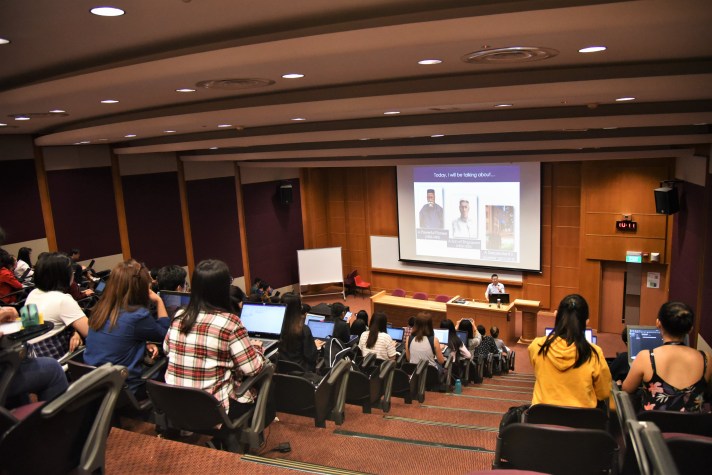
Speaker Shawn Seah delivering a guest lecture on family history at the National University of Singapore. Photograph by Shawn’s team.
First, you have to do your homework.
The secret to success is in the pre-lecture preparation.
I spend time preparing for my lectures, developing or refining decks of slides with clear content, visuals, diagrams, and, sometimes, even videos.
Think about the level and background of your audience.
Tweak your content to be accessible and relevant to them.
Even if I am familiar with the material, I still think about what I want to say and rehearse up to seven times.
I will recite my lines, paying attention to where words roll off the tongue smoothly.
I will sharpen or simplify sentences. I’ve found that, unsurprisingly, shorter, sharper sentences work best.
If inspiration strikes, a catchy soundbite or elegant turn of phrase will emerge, and I write it down and recite it a few times.
If I need to re-familiarise myself with the content, I will read up. (Yes, I even read books that I have written before.)
Even if I have used my deck of slides many times before, I will still review the slides. Sometimes, I spot glaring typos in my slides.
At other times, I see phrases that make me cringe.
And at other times, I see facts, arguments, or reflections that have evolved since my last lecture. I will take the opportunity to make sure my materials are as up-to-date as I possibly can.
Reviewing, reciting, and rehearsing your lecture materials will help ensure that you are able to give your best to the audience.
Second, on the actual day, warm the crowd up before you begin.
In the case of a guest lecture, you do not personally know many of the people in the crowd.
In contrast, when you are giving lectures at junior college or you are the regular lecturer for a course, you typically already know your tutorial classes or form classes.
This can make a huge difference.
It’s because you are speaking essentially to people you know personally if you have spent prolonged periods of time with the same students.
And what tends to happen after a semester, or a year, or two, is that even for the rest of the students who are not in your tutorial classes or form classes, they would recognise you and you would gradually recognise them.
It is easier to build rapport with people you recognise than people you don’t.
So, when giving guest lectures, you might have to speed up this process and start speaking with a few people in the room before the talk starts.
At the very least, speak with the professor who invited you and his or her teaching assistant. Understand them and what they are interested in.
Speaking with people before the talk starts will help them get to know you as a person; you can better understand some of the things they came here to learn about; and you can have a few friendly faces to look at during your lecture.
Maintain eye contact with your audience to show them that you are engaging with them.
Third, have multiple hooks.
People are interested in different things.
This is perfectly natural.
When delivering a lecture, you have to hold the attention of your audience and if you are only appealing to one segment or group, you might bore others.
So, the idea of multiple hooks is essentially to speak about things that relate to different people and in a way that would interest them.
A hook is essentially how you grab hold of your audience’s attention and make it engaging and relevant to them.
Taking history as a starting point, some history lecturers you might have come across can inspire sleepiness.
Yet others, teaching the exact same material, can inspire miraculous feats of scholarship, often beginning with an intriguing question, a surprising fact or figure, or a compelling anecdote.
Many years ago, I attended a lecture given by a talented teacher. Let’s call him Mr H.
I was struck by how Mr H always seemed to be linking the past and present together, drawing links between historical events and life today. He would ask thought-provoking questions for more cerebral students to mull over and then immediately jump to talking about more day-to-day things like movies, newspapers, and computer games. He would show dramatic pictures on one slide and raise detailed discussion points on the next.
He was essentially drawing on the principle that you have to vary your approaches to maintain people’s interest. He related knowledge to different things that different people were keen on.
This is related to my next point.
Fourth, involve your audience.
Most lectures tend to be a one-way street. The sage on the stage delivers the wisdom; everyone else listens respectfully.
But what if lectures were interactive?
After all, some learners learn by participating actively.
I use many questions when delivering my lectures. Other than increasing engagement and participation, it actually helps learning because students are now thinking of the answers.
You can also quiz the audience, by using live polls or quick quizzes to gauge their understanding.
You can also ask people to raise their hands: “With a show of hands, how many of you…” Their raised hands will give you a sense of how many think, believe, or feel a certain way. If you want them to discuss some questions, you can even use “think-pair-share” to deepen engagement.
I used to love this one very much.
Basically, the core concept is to give them a question, problem, or debate topic to think about individually; then they can exchange ideas with their neighbour sitting next to them; and then they can volunteer to share with the entire class.
Fifth, speak conversationally.
There is such a thing as a “lecturer tone”.
You might have heard it before. You know what I am talking about.
There are many different tones from many different personas, like “a pastor tone”, “a Roman Catholic priest tone”, and definitely a “lecturer or teacher-y tone”.
One of my biggest secrets in delivering engaging lectures is that I simply don’t use a lecturer’s tone.
Instead, I just speak like my normal self: conversationally.
I also use clear and simple words, phrases, and sentences — those I would actually say on a day-to-day basis.
Part of the fear some people have is that if they use simple words, people would think they are simple.
But the surprising fact is that even very high-level people use simple words for communication.
Now, speaking conversationally doesn’t mean that you let all your bad habits out, like dropping “F” bombs all over the place or being plain mean, nasty, or rude.
In particular, I believe you do have to mind your Ps and Qs and remember to be sensitive and sensible.
Speaking conversationally is more like speaking nicely to your grandma, a fairly intelligent layperson whom you like.
For example, you wouldn’t say, “Ah Ma, to analyse the cake popularity situation (or lack thereof), we have conducted a multi-variate regression analysis, assuming the heteroskedasticity of the error terms, to find out the correlation between various factors…”
No, you would simply say, “There are many reasons why people might not like your cake, Ah Ma.”
(And if you are Asian like I am, you will probably hasten to add politely and respectfully, “But I love your cake, Ah Ma.”)
Apply that same principle to lecturing.
If you understand something deeply, there has to be a way to put it across more simply, accessibly, and conversationally, without big, fancy, and confusing words.
And your listeners will thank you for doing so.
Sixth, notwithstanding, you must still be a “sage on the stage”.
Direct instruction remains important in delivering lectures.
At the end of the day, a strong delivery is still needed: basically, being able to stand confidently in front of a large room, command the audience, and directly deliver a strong message.
A strong delivery is active. The speaker must look at the audience and, while delivering the message, sense changes in mood and feeling.
When I was a teacher many years ago, this concept was known to me as “withitness”.
Withitness is the capacity to perceive the learning needs of students, notice their subtle behaviour, understand their nonverbal and verbal cues, and respond quickly to unexpected situations.
You know how some teachers have eyes at the back of their heads?
That’s withitness.
When the audience is starting to lose interest, the speaker must pick up the pace, or change volume, or even pause dramatically.
When the audience starts to lean forward and attention has been granted, the speaker must not lose the interest, but build on it and continue delivering point after point right home.
The speaker must deliver the firepower to the demands of the moment, adjusting slightly, refining the actual approach along the way.
Because I believe in a growth mindset, I believe delivery can be strengthened through training and practice over time.
You can also learn about lecture delivery from observation.
If you observe good speakers, what do you see or hear? How did they deliver the message such that you were mesmerised?
Over time, you can grow into a sage on the stage.
In summary
Prepare your slides, script, and content, and rehearse well, in advance of your lecture.
Warm up the crowd early on the day itself, build rapport, and be approachable.
Prepare multiple points of interest to hook the audience, grabbing their attention and making them think.
Think through several good, open questions that you would ask. Ask the audience to participate at relevant junctures.
Practise speaking conversationally in clear, concrete, and simple terms that people can understand.
Confidently and actively deliver your lecture, commanding the room, and paying attention to what is happening and adjusting slightly along the way.
Of all these reflections, if I had to choose the most important point, I would return to what I shared right at the start: I think preparation and practice are the most important.
If you prepare, rehearse, and review how you deliver your lecture, to the best of your ability, the audience will likely see, hear, and feel the strength of your message.
And over time, with more practice and experience, you will find that like me you enjoy giving engaging lectures as much as other people enjoy listening to what you have to share.
Thank you for reading.
Cheers, Shawn Seah
(The original story was first posted on my Medium blog. It was, rather surprisingly, one of the most viewed, most read, and highest earning articles. This story was updated on 1 September 2024.)




 Shawn Seah Li Song
You must be logged in to post a comment.