Remembering Mrs Elizabeth Choy’s Courage and Compassion at Changi Chapel and Museum

It was a slightly surreal experience as an author to hear someone else perform my work.

Storyteller Tanya Ang brought one of my books to life at Changi Chapel and Museum.

Her storytelling was organised by HeritageSG as part of the Children’s Day celebrations from 2 to 4 October 2026, organised across several Singapore heritage sites paired with a corresponding Singapore history book.

In my case, Elizabeth Choy: Singapore’s Kind Heroine from my children’s book series Our Amazing Heroes, was a natural fit for Changi Chapel and Museum because Elizabeth Choy’s wartime experiences were intertwined with the history being explored at the museum.
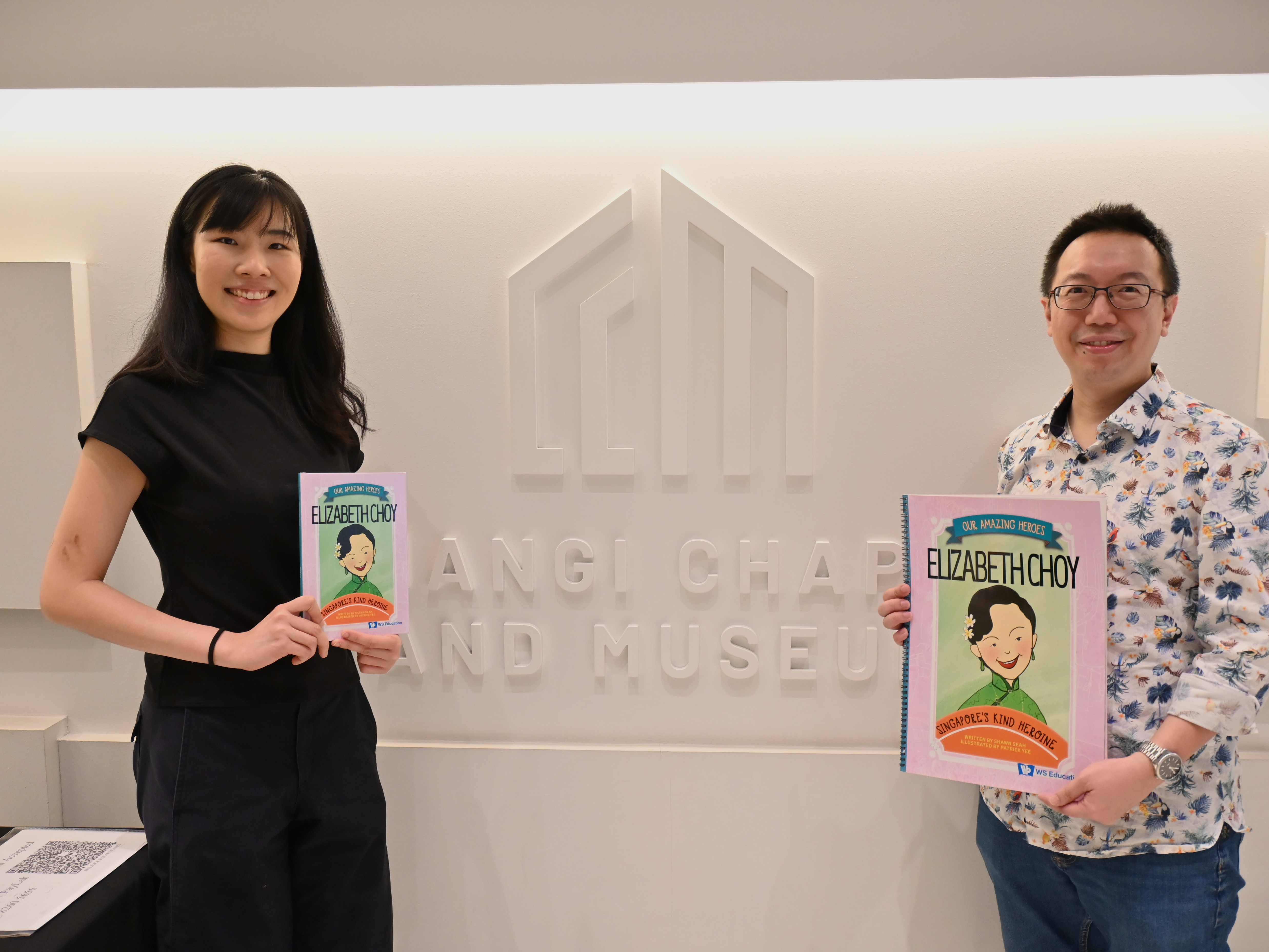
Performer Tanya Ang and author Shawn Seah holding up books on Elizabeth Choy: Singapore's Kind Heroine.
Storyteller Tanya Ang and author Shawn Seah with Elizabeth Choy: Singapore’s Kind Heroine. Photograph by Shawn’s team.

As part of the programme, Tanya performed the story for different groups of participants over three mornings.

Children and their parents listened to stories, grappled with questions, and crafted their own medals. Above all, they reflected on how they could be courageous and compassionate, like Mrs Elizabeth Choy.

Regrettably, I could not be there to sit in for all the sessions as I was busy, but I managed to go down to the museum over the weekend.

Whenever I visited, I had a lovely time meeting parents and their children, museum volunteers, my fellow Singaporeans, and visitors from Australia and England.

Different Approaches to Storytelling

It was a slightly surreal experience as an author to hear someone else perform my work.

Children’s book writers spend much time and effort on the precise words, sentences, and paragraphs on each spread. More broadly, thinking about the specific words we want to array on the page is also true of narrative non-fiction writers in general.

That is why it can be fascinating and interesting to see what happens when another storyteller takes the words, sentences, and paragraphs we crafted, and makes them her own.

I enjoyed watching Tanya perform, and her storytelling approach was different from mine in many respects. Watching her perform gave me a useful opportunity to think harder about the different ways we can introduce history to children.

For example, she was comfortable bounding beyond the boundaries of my book. She asked the children questions beyond what was written on the page, and brought in the surrounding historical context in her own words. She treated the book flexibly as a storytelling resource, rather than following every sentence closely. She did read some of the more pertinent passages out loud too. She focused on engaging the children and interacting with them, which is something I personally believe in and was reminded to do more of.

My own historical storytelling approach is slightly different. I think that my way, perhaps, reflects my past working life as a teacher (or maybe it is undiagnosed OCD).

As an educator, I tend to stay closer to the text, often word for word. I often pause to explain the historical context around particular phrases or offer more details, but only after I have covered the particular, specific historical narrative first. For key points, I will even repeat, repeat, repeat.

I reflected that I tend to make fuller use of the illustrations in the double-page spreads, drawing attention to details or actions and asking them what they notice before moving the story forward.

We did share many commonalities in interactions. I liked how she engaged the children. As for me, I sometimes use a simple “show of hands” or call for quick responses to questions like, “Did they live happily ever after?” or “What do you think happened next?”

I also usually use “withitness” to adjust my pace, volume, or eye contact to the children. As an example, I have reflected on how to give an amazing assembly talk to primary school pupils.

However, I still enjoyed watching Tanya perform and did not steal her thunder. She did great justice to my book and even introduced me as well (very kind of her). And there are many ways to tell a story after all. Education and entertainment can be combined in many ways, and a story can acquire a different life in the hands of different storytellers.

What matters most to me is that children are engaging with the material; thinking; asking questions; and learning.

Now, it is not always easy for children to pay complete attention, concentrate, or stay focused all the time. To me, it is A-OK even when children make faces, laugh, or fidget. I mean, at my age, I still have ants in my pants.

As long as any historical storyteller has tried their level best to engage with the children, some self-forgiveness is in order.

Revisiting the Double Tenth Incident

Over the years, I have visited Changi Chapel and Museum several times. I will not spoil the visit for you, but here are some pictures that might encourage you to pay a visit.

For full disclosure, do note that this is a relatively small but deeply meaningful museum.
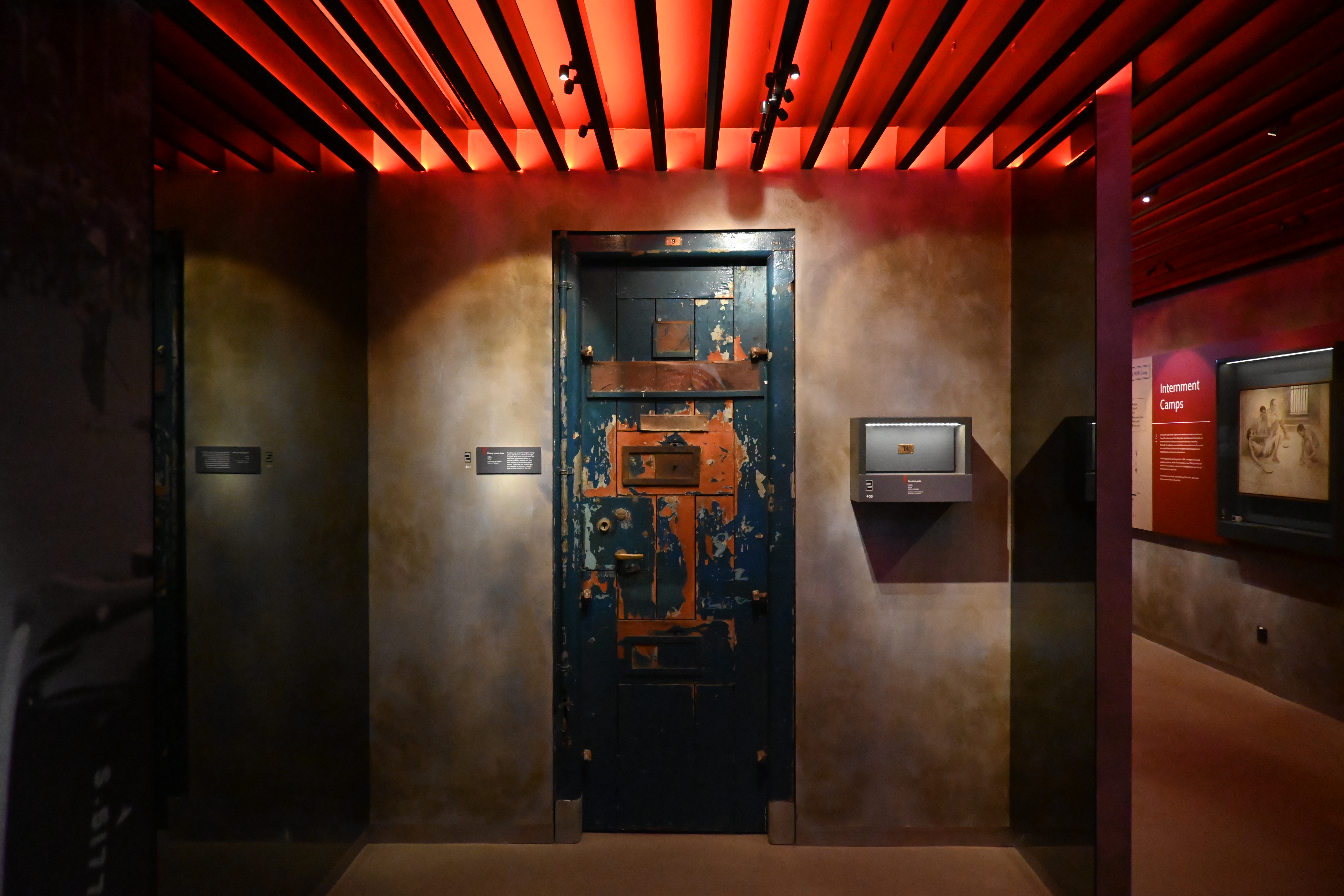
Changi prison door at Changi Chapel and Museum.
Changi prison door at Changi Chapel and Museum. Photograph by author.
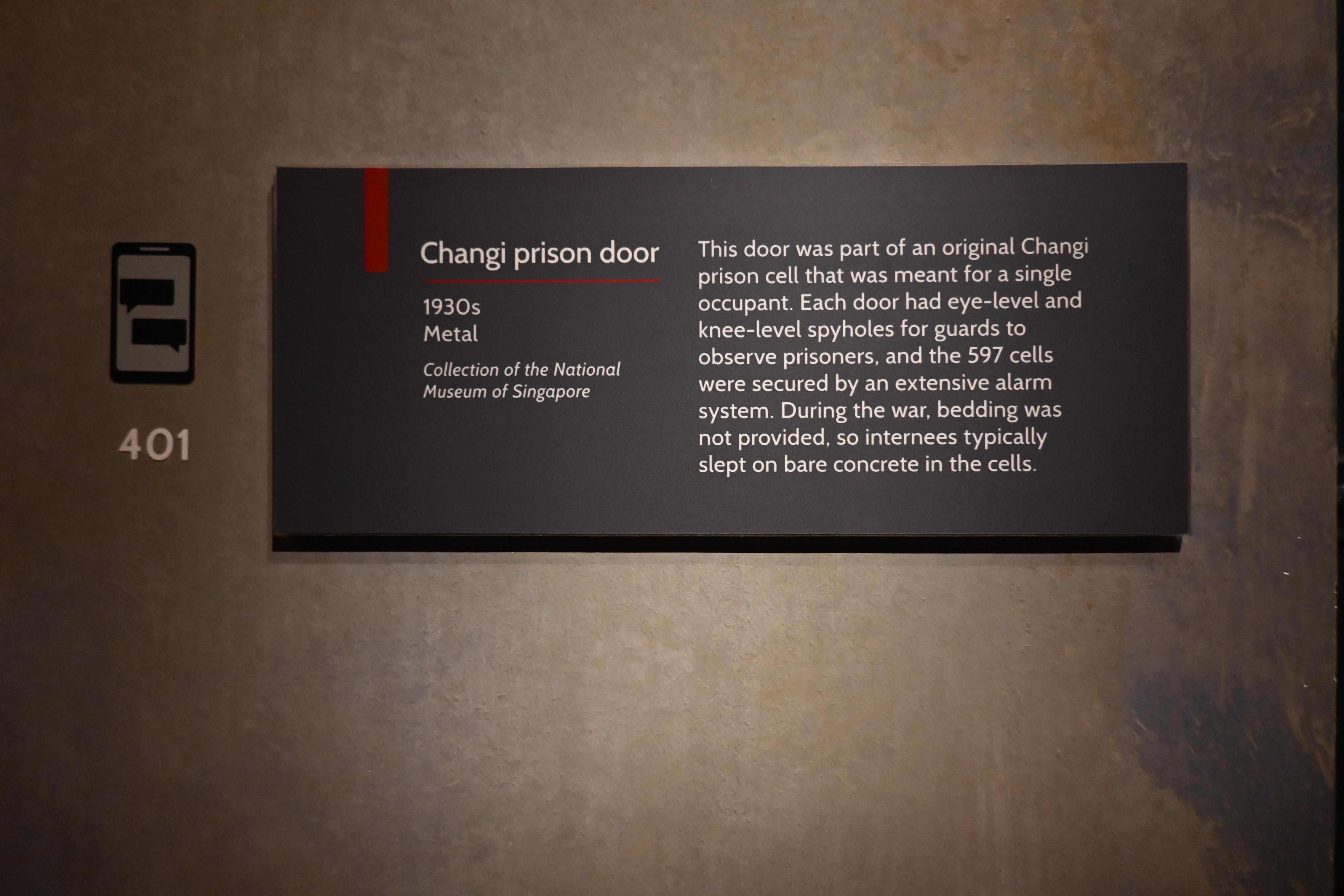
Museum label about the Changi prison door at Changi Chapel and Museum.
Museum label about the Changi prison door. Photograph by author.
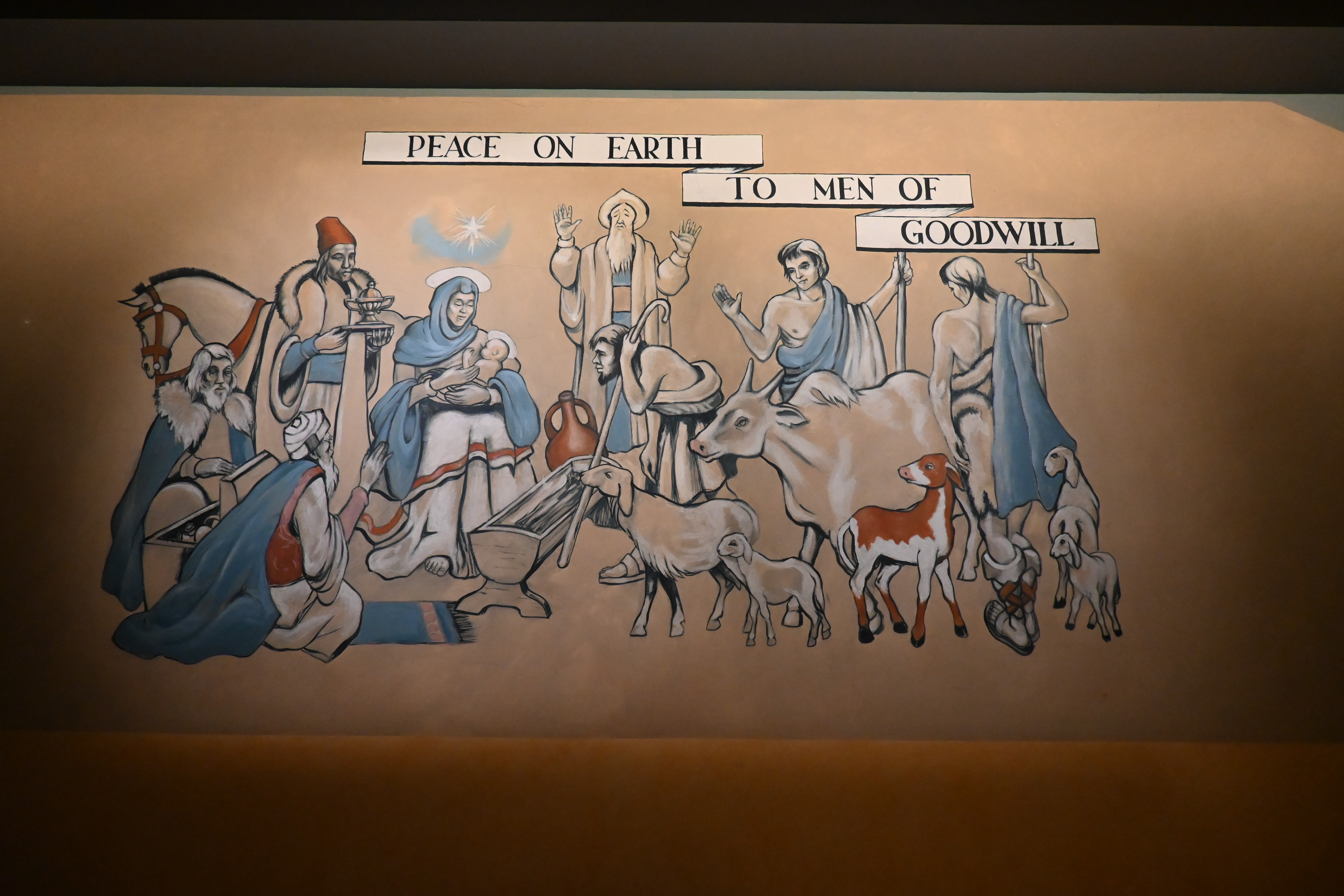
A Christian wall mural at Changi Chapel and Museum.
Wall mural (replica) at Changi Chapel and Museum: “Peace on earth to men of goodwill.” Photograph by author.

One thing that really stood out to me during this time was revisiting the Double Tenth Incident.

The name refers to 10 October 1943, the tenth day of the tenth month, when the Kempeitai, the Imperial Japanese military police, began arresting civilian internees whom they suspected of involvement in an attack on Japanese shipping in Singapore’s waters.

The context was that, in September 1943, British and Australian commandos carried out Operation Jaywick, a daring raid. The operation succeeded in damaging or sinking several Japanese ships, and the commandos escaped. The Japanese did not quite realise that the attack had been mounted by an Allied commando force from outside Singapore. Instead, they suspected that people within Singapore had assisted the raid.

On 10 October, the Kempeitai raided Changi Prison and began arresting and torturing suspects. More arrests followed. This tragic episode subsequently became known as the Double Tenth Incident.
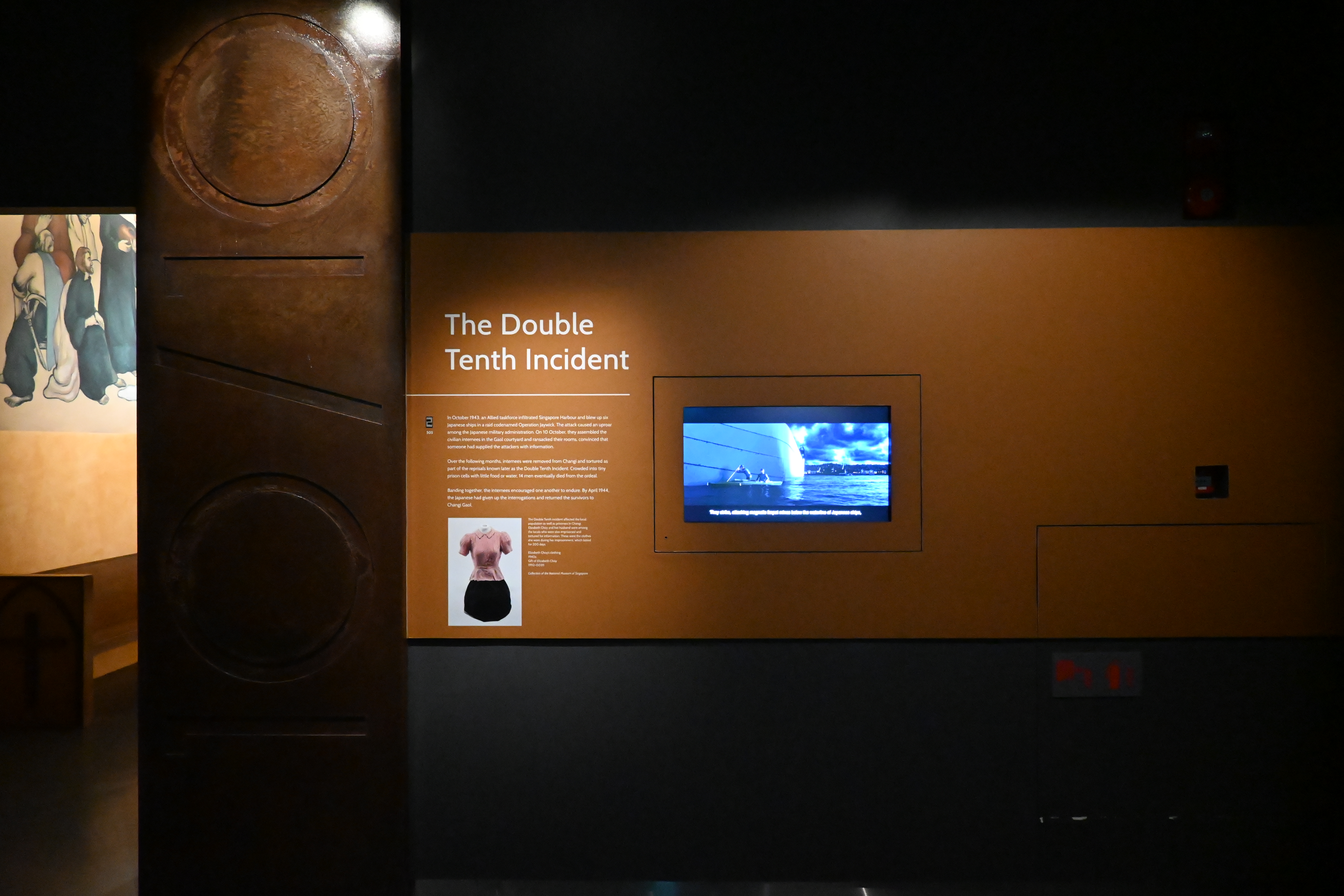
The Double Tenth Incident wall panel and video at Changi Chapel and Museum.
The Double Tenth Incident wall panel and video at Changi Chapel and Museum. Photograph by author.

Among those caught up in the crackdown were Mr Choy Khun Heng, and subsequently his wife, Mrs Elizabeth Choy. The Choys had been smuggling food, medicine, money, and messages, including radios.

As a result, Elizabeth was imprisoned for almost 200 days, as well as interrogated and tortured.
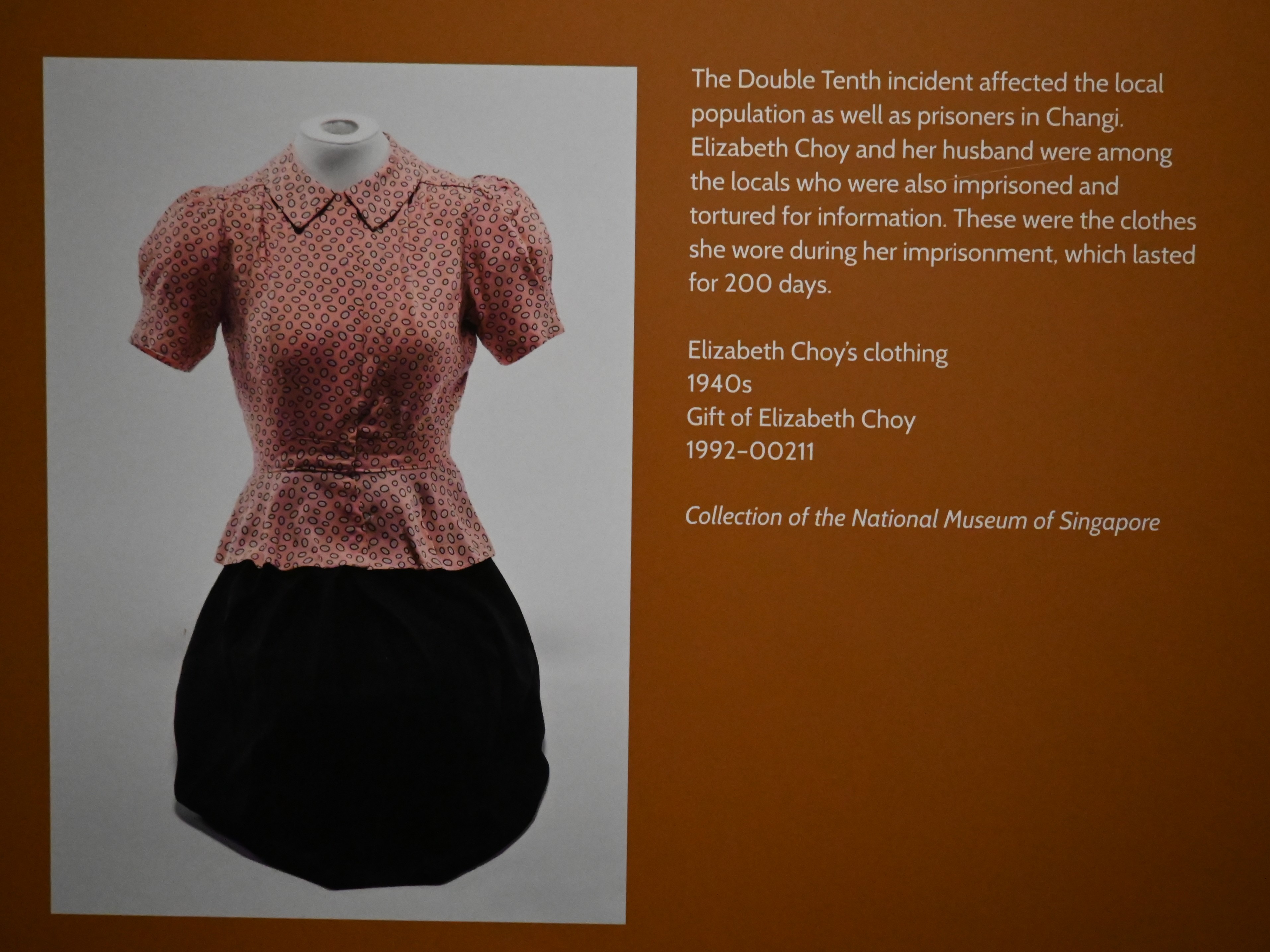
Photograph of Mrs Elizabeth Choy's clothing.
Picture of Mrs Elizabeth Choy’s clothing that she wore during her imprisonment. Photograph by author.

My children’s book on Mrs Elizabeth Choy in Our Amazing Heroes touches on this pivotal episode. When I walked about Changi Chapel and Museum and encountering the broader, wider story again was a reminder that Mrs Elizabeth Choy’s experience formed a part of the broader, wider history of the Japanese Occupation of Singapore.

What Can Children Learn From Elizabeth Choy’s Story?

There are several lessons children can take away.

The first is that courage does not necessarily mean military courage (just like Total Defence does not simply refer to only military defence).

Mrs Elizabeth Choy was not a soldier, yet she chose to help people who were suffering, even placing herself at considerable risk.

Most of us will (hopefully!) never face the challenging circumstances Mrs Elizabeth Choy courageously faced. However, in our lives, we will encounter many moments when we have to decide whether to help someone, speak up, or do the right thing, even when it might be easier not to.
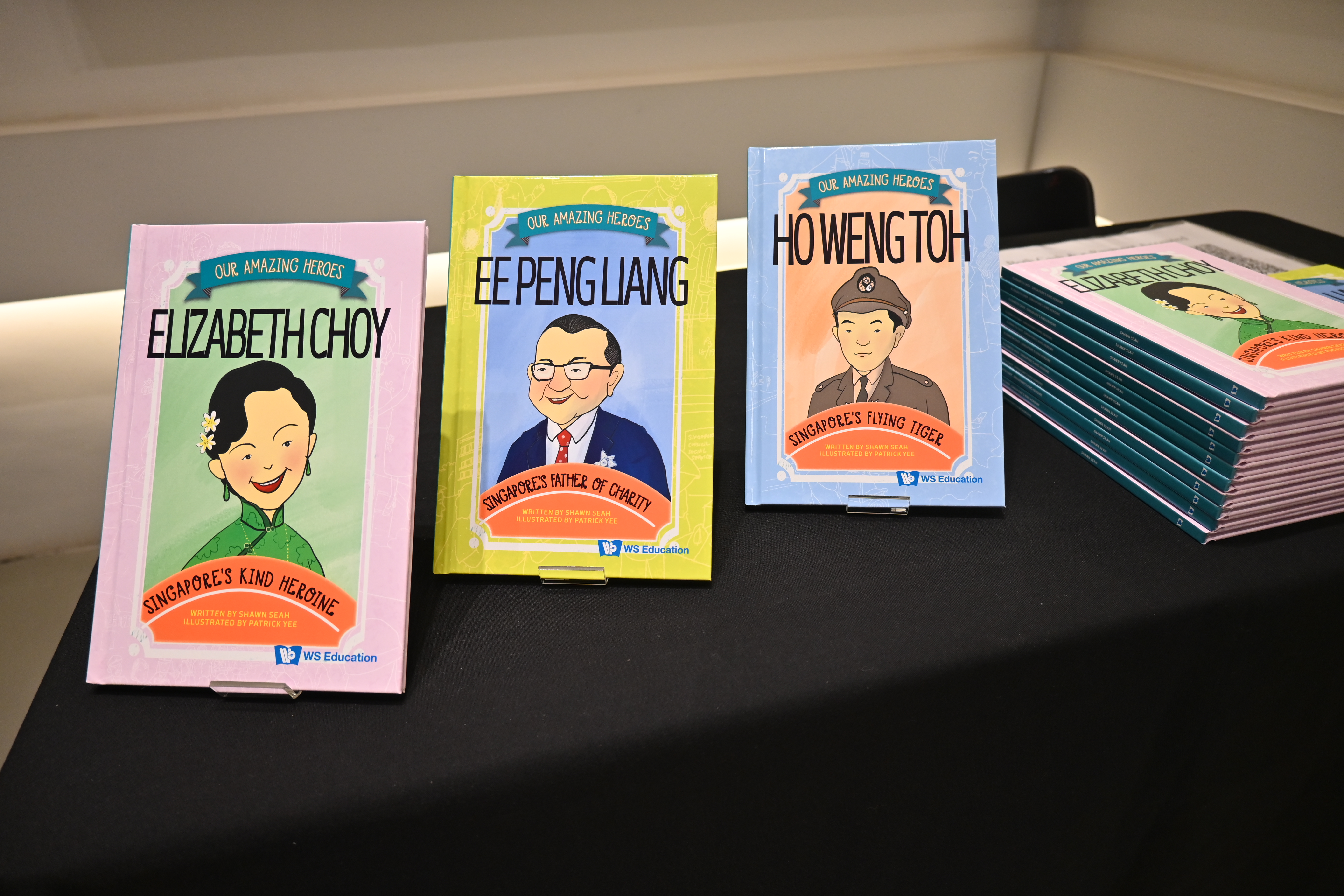
The children's book series, Our Amazing Heroes, authored by Shawn Seah and illustrated by Patrick Yee.
The children’s book series, Our Amazing Heroes, authored by Shawn Seah and illustrated by Patrick Yee. Books were on sale at Changi Chapel and Museum from 2 to 4 October 2026. Photograph by Shawn’s team.

We remember heroes and heroines such as Mrs Elizabeth Choy because of how they responded to extraordinarily difficult circumstances.

Her courage was accompanied by compassion and a willingness to contribute to society. I hope that younger readers will be inspired by her story, and the stories of Singapore’s amazing heroes and pioneers.

In our own little ways, each of us has a part to play in keeping Singapore strong.

Thank you for reading.

Cheers,
Shawn Seah

About the Author

Shawn Seah is a published author and public speaker who makes Singapore’s history come alive through engaging storytelling. He is the author of the children’s non-fiction series Our Amazing Pioneers (2023) and Our Amazing Heroes (2025), fully-illustrated books aimed at primary school pupils. He has also written non-fiction books for the general reader on family history and Singapore pioneers like Seah Eu Chin and Seah Liang Seah. One of his books, My Father’s Kampung: A History of Aukang and Punggol, was a finalist for Best Non-Fiction Title at the Singapore Book Awards 2021. A recipient of the NUS Outstanding Young Alumni Award (2023), Shawn speaks regularly about family history research, Singapore history, and the art of historical storytelling at schools, literary festivals, and museums.
Writing Crossing Borders: Reaching Beyond Singapore, Part II

Last year, I blogged about reaching audiences beyond Singapore, in “Writing Crossing Borders: Reaching Beyond Singapore”.

Much of my written work has been rooted in Singapore, because I write about local subjects like Singapore history, family history, and heritage.

However, writing about local topics does not mean just local reach.

For example, as I shared before, my first book, Seah Eu Chin: His Life & Times, was cited by UK-based historian Dr Stan Neal in his Routledge chapter, “Mediators, migrants and memories of colonial Singapore: the life and legacy of Seah Eu Chin”, published in Singapore: Two Hundred Years of the Lion City.

Also, I recently learnt that Seah Eu Chin: His Life & Times was cited in Bernard Z. Keo’s 2025 article, “Kapitans and Unofficials: Ethnic Intermediaries in the Straits Settlements, 1786–1942”, published in the Journal of the Malaysian Branch of the Royal Asiatic Society.

These citations suggest that research on Seah Eu Chin and Singapore Chinese history remain relevant. More broadly, there is interest in regional scholarship on the Straits Settlements, colonial Singapore, and Southeast Asian history.

Similarly, another of my books, My Father’s Kampung: A History of Aukang and Punggol, was recently referred to in Bryan Benjamin Yu Xian Goh’s 2026 University of Michigan PhD dissertation, “Choreographing Charisma: Catholicity and the Charismatic Renewal Movement in Insular Southeast Asia (1965 to 2020)”. (And congratulations to the newly-minted PhD on the successful completion of his thesis!)

My Father’s Kampung was also cited in Chan Ying-kit’s 2021 article, “Hougang: The Origins of a ‘Safe’ Alternative Constituency in Singapore”. As far as I am aware, he was a Visiting Scholar at Thammasat University in Thailand publishing in an overseas journal.

Such academic citations remind me again that my Singapore stories can and do travel overseas. While they may not always reach mass audiences, they can still cross borders through scholarship. This is a small, encouraging reminder that Singapore history and heritage has the potential to reach regional and international audiences.

My Singapore stories can also travel overseas through translations (like the Chinese translation of Seah Eu Chin: His Life & Times), media mentions (like in Sin Chew Daily, Sohu.com, Guancha), and kind readers who find value in them.

Such deeply Singaporean stories can still speak to wider, more universal questions of identity and belonging, leadership, and community.

For me, this is part of my wider writing journey. The journey towards being read by academics in the wider region or referred to in dissertations written in the USA may be gradual, but it is real: writing about Singapore matters and can cross borders.

I genuinely hope that such small successes in my writing journey can inspire you.

Thank you for reading!

Cheers,
Shawn Seah

About the Author

Shawn Seah is a published author and public speaker who makes Singapore’s history come alive through engaging storytelling. He is the author of the children’s non-fiction series Our Amazing Pioneers (2023) and Our Amazing Heroes (2025), fully-illustrated books aimed at primary school pupils. He has also written non-fiction books for the general reader on Singapore family history, Teochew pioneers like Seah Eu Chin and Seah Liang Seah, and a Singapore Book Awards 2021 finalist My Father’s Kampung: A History of Aukang and Punggol. A recipient of the NUS Outstanding Young Alumni Award (2023), the talented historical storyteller speaks regularly about family history research, Singapore history, and the art of storytelling at schools, literary festivals, and museums.

The Story Behind: “Searching for One’s Roots 2.0”

In family history, we are familiar with people searching for their roots.

But what happens when a sentient artificial being wishes to learn where it came from?

I recently attended the launch of the Sengkang Sci Fi Journal, formerly the Sengkang Sci Fi Quarterly.

This Singapore-based, literary journal is dedicated to speculative fiction and adjacent genre stories, harkening back to the golden age of sci-fi where short fiction pioneered the art of creating narratives within imagined futures. It supports short stories that push the limits of imagination using the frame of technology to entertain and examine. I was heartened to see its Chief Editor Mr Zubin Jain building and supporting a community of writers in Singapore imagining new futures through speculative fiction.

(Thank you Zubin and team for supporting and building this community. Incidentally, from his launch party, I learnt that instead of requiring guests to write their names on stickers, you could ask them to write about their favourite novel or film! I was “Dune”.)

As a Singaporean author focused on non-fiction, I usually write about family history and heritage.

My small contribution to Issue 3, “Searching for One’s Roots 2.0”, is an experimental step into sci-fi historical fiction. I thought about how I could write a piece that combined family history; Artificial Intelligence, which is all over the news these days; and an engaging plot.

I also experimented with structure. That is why I tried writing my piece as a movie script, using dialogue and direction to carry the story.

Set in the far distant future, my sci-fi story follows a sentient humanoid being searching for its roots, only to discover that its origins are more human, and more unexpected, than it had initially imagined.

Sentient machines are built in the image of their creators: and their creators, in turn, are human, who grapple with issues like searching and longing. Some answers must be experienced, to be found.

If this teaser (or is it a spoiler?) to my first sci-fi historical fiction piece speaks to you, this may be worth a read: “Searching for One’s Roots 2.0“.

Thank you for reading!

Cheers,
Shawn Seah

About the Author

Shawn Seah is a Singaporean author who has written several non fiction books, including the children’s non-fiction series Our Amazing Heroes and Our Amazing Pioneers. A storyteller at heart, he has appeared in the media and at literary festivals to share stories about Singapore’s history and heritage, and the art of historical storytelling at schools, literary festivals, and museums. Shawn is currently experimenting with sci-fi historical fiction.

“Elizabeth Choy: Singapore’s Kind Heroine” in Red Dot Stories’ Courage Remembered Series

The people behind Red Dot Stories narrate stories of the quiet, often unseen contributions of ordinary Singaporeans, acts of kindness, resilience, and courage that strengthen our society and, in turn, our collective defence.

And they have released this amazing video featuring Karen Hoisington and Claire Koh talking about Elizabeth Choy: Singapore’s Kind Heroine (see YouTube and Instagram videos below)!

I am delighted to share that this video is based on my children’s book series, Our Amazing Heroes (2025), written by me and illustrated by the talented artist Patrick Yee.

The trailer was released earlier (see YouTube and Instagram videos below):

As a Singapore history author writing about Singapore pioneers, I support National Education and Total Defence. I believe that our unique Singapore stories help us understand who we are, what values define us, and what we must protect.

As we reflect on the importance of Total Defence Day (15 February), we must appreciate that Total Defence is more than just military readiness, which is important, but about social cohesion, economic resilience, digital and online responsibility, civil defence, and psychological strength.

In 2025, talented illustrator Patrick Yee and I launched our children’s book series Our Amazing Heroes to share stories of courage, compassion, and contribution by Singapore pioneers. This series was a sequel to Our Amazing Pioneers (2023), a children’s book series of Singapore’s pioneers, including Teochew pioneers Seah Eu Chin, Seah Liang Seah, and Tan Seng Poh, among many others.

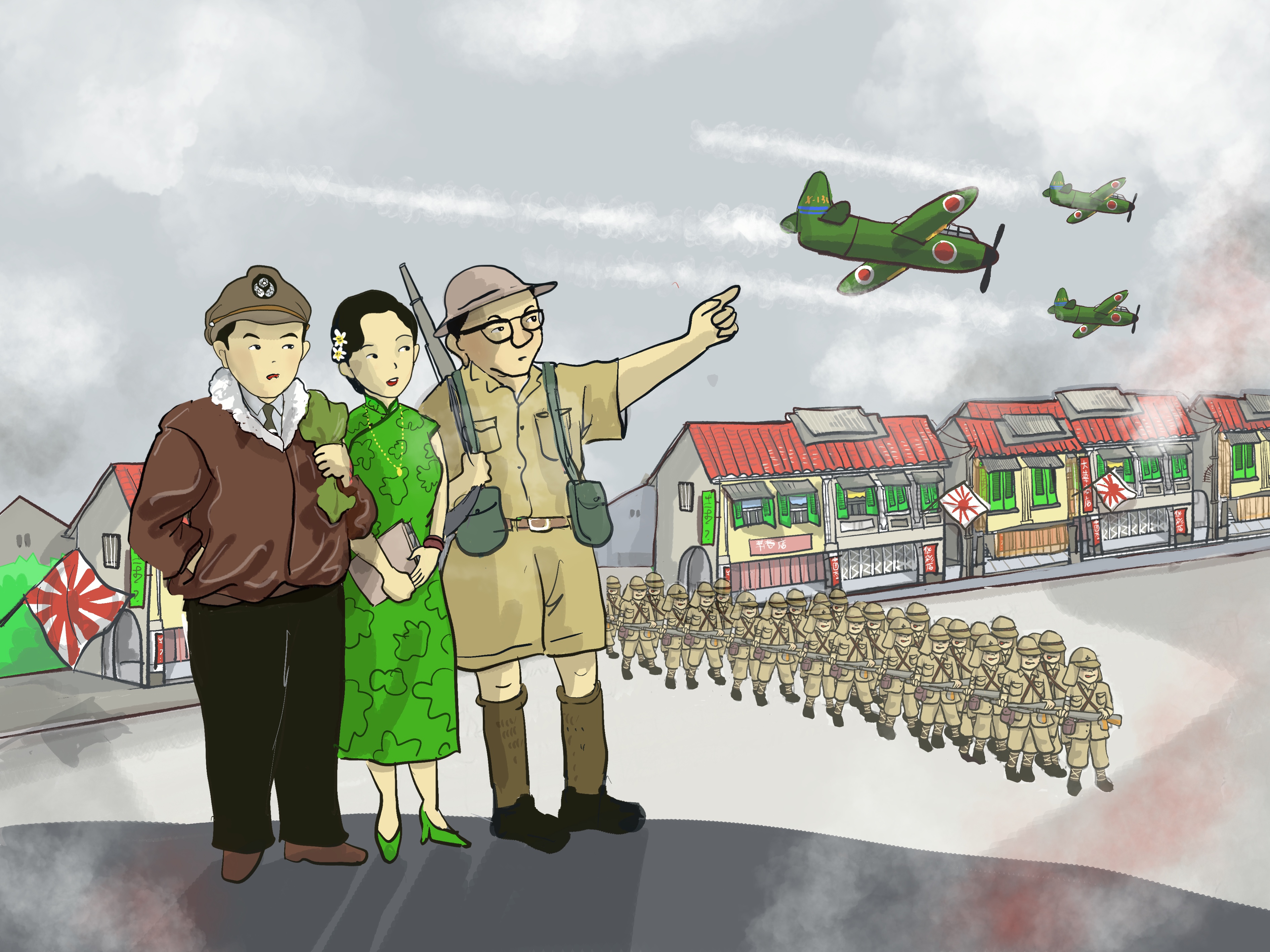
Artwork of Captain Ho Weng Toh, Elizabeth Choy, and Ee Peng Liang from Shawn Seah's children's book series, Our Amazing Heroes.
From left to right, Captain Ho Weng Toh; Mrs Elizabeth Choy; and Dr Ee Peng Liang depicted by illustrator Patrick Yee.

One of the historical figures Patrick and I brought to life through Our Amazing Heroes was Mrs Elizabeth Choy. As Singapore’s kind heroine, she demonstrated courage and compassion even in the darkest days of the Imperial Japanese occupation of Singapore.

In my children’s book Elizabeth Choy: Singapore’s Kind Heroine, I wrote about how she was arrested for smuggling supplies to prisoners of war, how she endured imprisonment and torture, and how she remained steadfast.

To mark Total Defence, such significant examples matter. They show our young that courage and compassion under pressure are real.

The team behind the video drew inspiration from the books and illustrations as part of their base material. I was genuinely encouraged to see how thoughtfully the values were brought across. The video brings out strong National Education and Total Defence themes for children in a way that is clear, accessible, and engaging.

As a Singapore history author and public speaker, this is what I believe in. I often tell pupils during school assembly talks that everyone has a role in keeping Singapore strong.

As we remember the importance of Total Defence, I hope this video encourages meaningful conversations. I hope it reminds our young Singaporeans that they are not bystanders in Singapore’s story, because every one of us has a part to play.

Thank you for reading.

Cheers,
Shawn Seah

About the Author

Shawn Seah is a published author and public speaker who makes Singapore’s history come alive through engaging storytelling. He is the author of the children’s non-fiction series Our Amazing Pioneers (2023) and Our Amazing Heroes (2025), fully-illustrated books aimed at primary school pupils. He has also written non-fiction books for the general reader on Singapore family history, Teochew pioneers like Seah Eu Chin and Seah Liang Seah, and a Singapore Book Awards 2021 finalist My Father’s Kampung: A History of Aukang and Punggol. A recipient of the NUS Outstanding Young Alumni Award (2023), he speaks regularly about family history research, Singapore history, and the art of storytelling at schools, literary festivals, and museums.

Reflections: Talking about Street Names at the Singapore Writers Festival 2025

I enjoyed myself at the Singapore Writers Festival 2025!

Here are some pictures from my day at The Arts House at The Old Parliament.

The facade of The Arts House at Old Parliament.
The Arts House at the Old Parliament, during the Singapore Writers Festival 2025! Photograph by author Shawn Seah.
Author and speaker Shawn Seah at the Singapore Writers Festival 2025.
Author and speaker Shawn Seah at the Singapore Writers Festival 2025. Photograph by Shawn’s team.
Behind the scenes at the Singapore Writers Festival 2025.
Behind the scenes: Brenda Yeoh, Shawn Seah, and Wesley Aroozoo getting ready for our Singapore Writers Festival 2025 panel. This photograph also reminds us of an age-old question: how many degree holders does it take to set up a laptop? Photograph by Shawn’s team.

As I wrote in a blog post earlier, “Street Names of Pioneers at the Singapore Writers Festival 2025”, I was part of a panel on the topic on street names.

As a history enthusiast, I am always excited to share about my family history, including my children’s non-fiction series Our Amazing Pioneers, which features many Singapore pioneers who have streets named after them, like Seah Eu Chin (Eu Chin Street), Seah Liang Seah (Liang Seah Street), and Tan Seng Poh (Seng Poh Road, Seng Poh Lane).

While admittedly it might sound somewhat self-indulgent, I felt pride and joy when I spoke to a full house of 75 attendees who packed the Screening Room at the Arts House, to listen to me talk about my family history books and my research!

On this exciting occasion, I was delighted and honoured to have distinguished Professors Victor Savage and Brenda Yeoh as my fellow panellists.

I found Victor to be a history and heritage buff, full of knowledge about Singapore’s history, which was unsurprising, but, above all, I personally found Brenda very kind, encouraging, and supportive.

(For example, during the panel discussion, Brenda helped to click through Victor’s slides, because he had so many of them, and somehow she got most of the order right! She was also so charming and friendly towards me.)

Wesley, Brenda, Shawn, and Victor at SWF 2025.
From left to right, Wesley Leon Aroozoo, Brenda Yeoh, Shawn Seah, and Victor Savage. Photograph by Shawn’s team.

Back when I was writing Seah Eu Chin: His Life and Times (first edition in 2017), I actually cited Savage and Yeoh’s books: Toponymics: A Study of Singapore Street Names and Singapore Street Names: A Study of Toponymics.

Their books on toponymics (the study of place names) provided a starting point for me to explore Singapore’s history through street names.

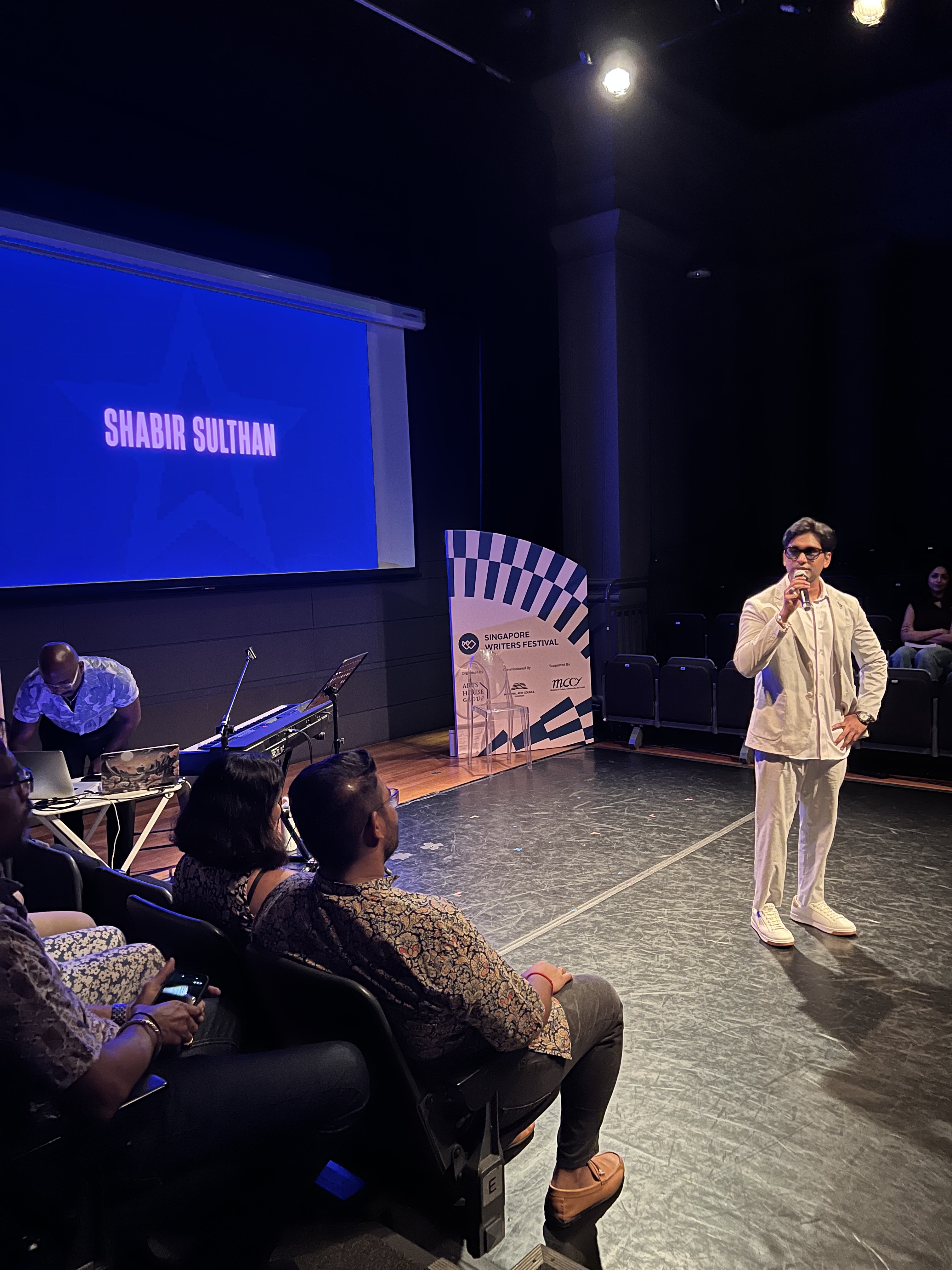
Other than my own panel discussion, I sat in for Shabir Sulthan’s performance lecture. I also enjoyed his session and learnt a lot, for example, of the importance of going regional or international as a content creator (he is big in India).

Shabir Sulthan at the Singapore Writers Festival 2025.
Shabir Sulthan performing and lecturing at the Singapore Writers Festival 2025. Photograph by author Shawn Seah.

Briefly, Shabir is a Singaporean composer and singer. Among his many musical achievements, he was one of the main singers for the 2021 National Day Parade (NDP) theme song, “The Road Ahead”. (Anyone who knows me know that I genuinely enjoy NDP songs.)

Through his stories and musical examples, like his composition of “Singai Naadu” (translated: “Singapore, my country”), he showed how melodies can be multicultural, carry our memories, and help us recognise the feelings we share as a people.

He shared that there was a sentiment in Singapore’s Indian community back in 2012: “Why was Munnaeru Vaalibaa the only Tamil NDP song?”

Shabir realised that older English-language NDP songs were of a certain style, generally upbeat and more action-oriented, aimed at building a new nation, and another common perception was that Indian songs had to come with the tabla and the sitar. However, he thought that Indian culture had so much more to offer.

He wanted to go for a more sentimental and emotional approach that went beyond traditional Indian music.

Although his song was not ready in time to be considered for the 2012 NDP, it was still played during the pre-parade segment, and also came to then-Prime Minister Mr Lee Hsien Loong’s attention that year.

Listening to Shabir’s perspectives (and his singing) not only opened my mind to different perspectives; it gave me an enjoyable experience at the Singapore Writers Festival.

Street names help us remember the amazing pioneers who built Singapore, while songs composed by Singaporeans like Shabir help us feel our connection to one another. Both are part of the larger Singapore Story and shape how we see our past and our future, “with hope, courage, and imagination”.

Thank you for reading!

Cheers,
Shawn Seah

About the Author

Shawn Seah is a published author and public speaker who makes Singapore’s history come alive through engaging storytelling. He is the author of the children’s non-fiction series Our Amazing Pioneers and Our Amazing Heroes, and speaks regularly about family history, Singapore Stories, and the art of storytelling at schools, literary festivals, and museums.
Street Names of Pioneers at the Singapore Writers Festival 2025

I am delighted to be invited to the Singapore Writers Festival 2025!

As an author and public speaker, I am always excited to talk about my writing, including my children’s non-fiction series, Our Amazing Pioneers, where my books bring Singapore’s pioneers to life for young readers.

On Saturday, 15 November 2025, from 3.30pm to 4.30pm, at The Arts House at The Old Parliament, Screening Room, I will be speaking as part of a panel on the topic: “Name Dropping: The Legacy of Singapore’s Street Names”, moderated by Wesley Leon Aroozoo.

This topic is close to my heart.

I am delighted to have distinguished professors Victor Savage and Brenda Yeoh as my fellow panellists.

In fact, back when I was researching and writing my first book, Seah Eu Chin: His Life and Times, I actually cited Savage and Yeoh’s books: Toponymics: A Study of Singapore Street Names and Singapore Street Names: A Study of Toponymics.

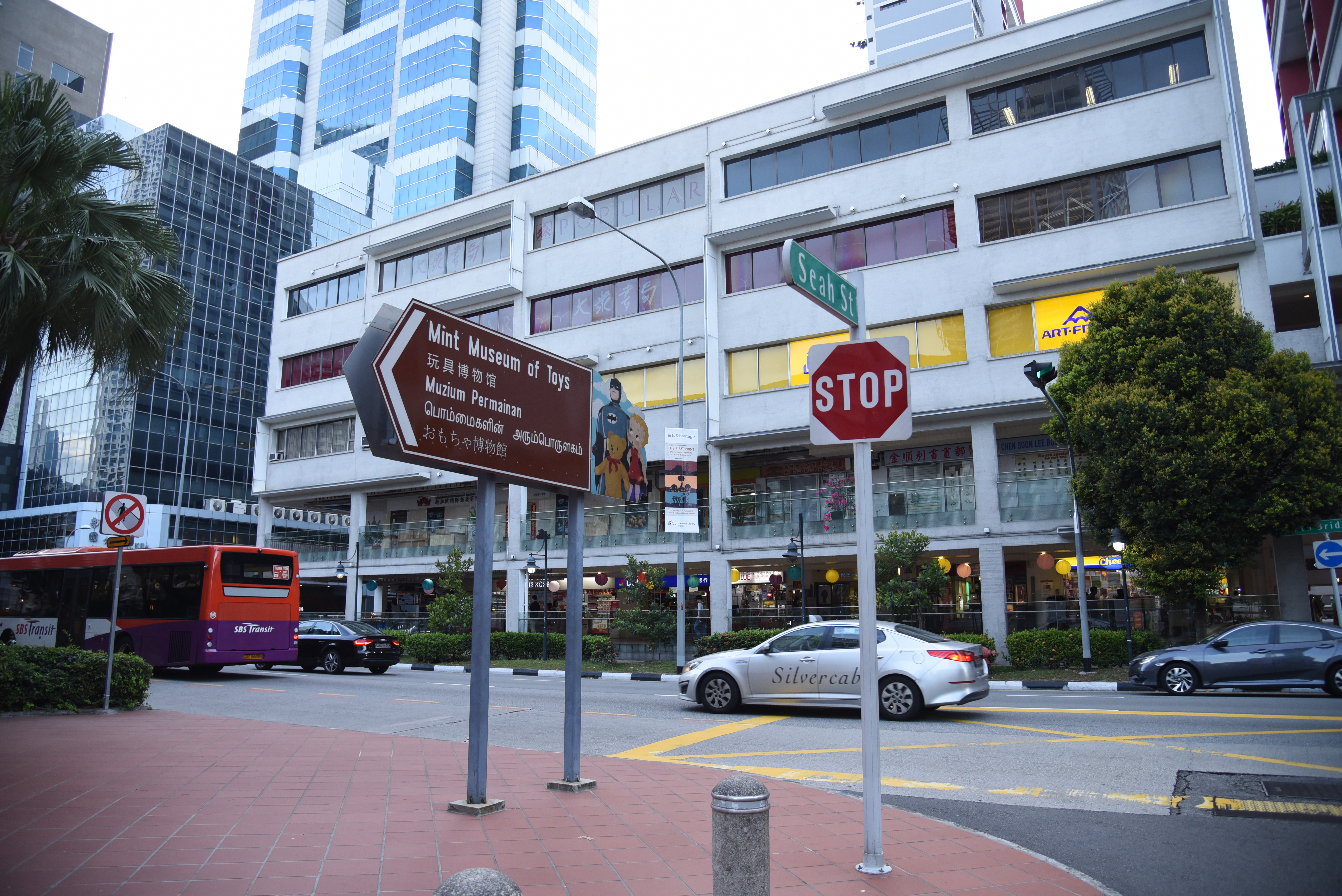
Seah Street sign and the Mint Museum of Toys sign, in Singapore.
Seah Street in Singapore. For a blog post on the Mint Museum of Toys, please visit “History and Heritage: My Visit to the MINT Museum of Toys“. Photograph by author Shawn Seah.
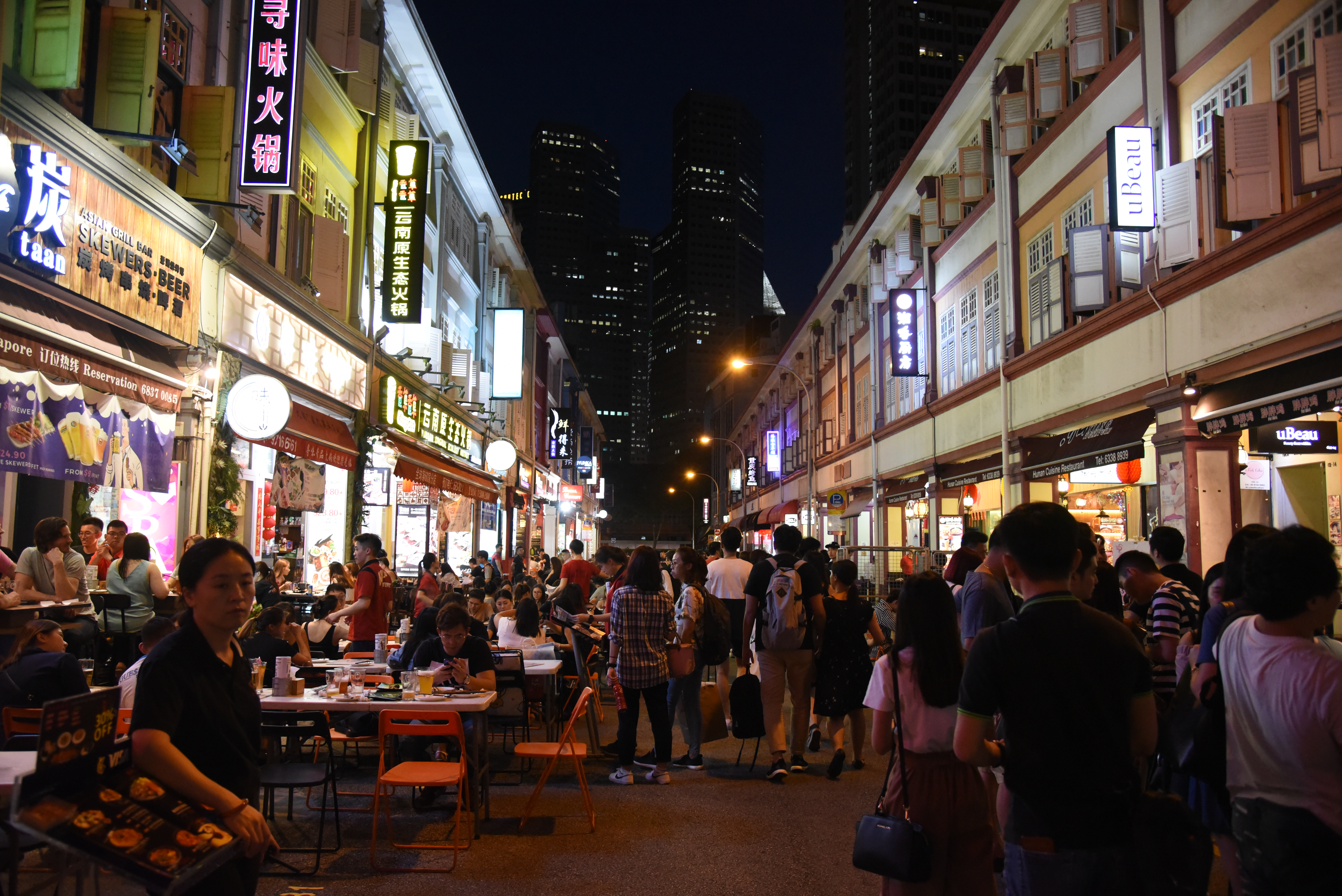
Singapore's Liang Seah Street at night, photographed by author Shawn Seah in 2019.
Liang Seah Street at night and on weekends is typically full of life. Photograph by author Shawn Seah.

They are experts in toponymics (the study of place names). Their books provided a starting point for me to explore Singapore’s history through street names. This is one reason why I’m looking forward to the panel discussion.

Also, the Singapore Writers Festival is one of Asia’s premier literary festivals, bringing together both international and Singapore authors to celebrate the art of storytelling and spark meaningful engagement with literature and the arts.

(In fact, I was a small part of the Singapore Writers Festival back in 2023. At the National Library’s Imagination Room, I narrated stories from Our Amazing Pioneers, covering Teochew leader Seah Eu Chin; Hakka heritage jeweller Ngeow Cher Seong; and charitable Arab Syed Omar Aljunied. Looking back, while the crowd was small, we had fun together!)

Author and speaker Shawn Seah as part of the 2023 Singapore Writers Festival, standing with fans and supporters.
Author Shawn Seah was part of the Singapore Writers Festival 2023. Photograph by Shawn’s team.

This year’s festival theme, “Shape of Things to Come”, is bold and forward-looking, inviting us to reflect on the past and present, and envision the future with hope, courage, and imagination.

As Singapore marks 60 years of independence, the 2025 edition of the Singapore Writers Festival features a special SG60 Homage track.

After all, 2025 is a timely opportunity to explore how Singapore’s identity and heritage continue to evolve in a changing world shaped by new trends and technological advancements, like developments in generative Artificial Intelligence and Agentic AI.

During my panel, I will share from my own writing journey, including the children’s non-fiction series Our Amazing Heroes and Our Amazing Pioneers, and my explorations into the stories of pioneers remembered through our street names.

These include our amazing pioneers remembered through streets such as Eu Chin Street, Seng Poh Road, Seng Poh Lane, Liang Seah Street, and Seah Street.

Many other pioneers I wrote about, like Syed Omar Aljunied, Edwin Tessensohn, and Naraina Pillai, also had streets named after them.

It is a privilege to be part of this conversation at Singapore Writers Festival 2025, as we look ahead with optimism while honouring the stories and histories that have shaped us.

I believe that community support for local writers is vital, and festivals like this remind us of the importance of coming together to celebrate our shared stories.

I warmly invite you to join us at the Singapore Writers Festival 2025 to listen, reflect, and be part of this conversation.

Thank you for reading.

Cheers,
Shawn


About the Author

Shawn Seah is a published author and public speaker who makes Singapore’s history come alive through engaging storytelling. He is the author of the children’s non-fiction series Our Amazing Pioneers and Our Amazing Heroes, and speaks regularly about family history, Singapore Stories, and the art of storytelling at schools, literary festivals, and museums.
Writing Crossing Borders: Reaching Beyond Singapore

Over dinner one day, a friend remarked to me:

“You’re definitely known in Singapore, especially for your family history writing, but I wonder about your reach beyond Singapore. Does anyone outside of Singapore even know about your writing or who the h*** you are?” (Friend’s identity has been hidden to ‘protect the innocent’.)

Well, it was a frank and fair question.

And it was a question that kept popping up in my mind.

Author and speaker Shawn Seah speaks at the Asian Festival of Children's Content with illustrator David Liew sitting on his right.
Author and speaker Shawn Seah at the Asian Festival of Children’s Content 2025, with illustrator David Liew. Photograph by Shawn’s team.

This question reminded me of guidance I received while at the Asian Festival of Children’s Content in May 2025. It went something along these lines:

“While you are recognised for writing non-fiction stories for Singaporeans, there might be value in giving some thought to writing something that lends itself more readily to regionalisation and internationalisation. That would mean translations, more products, and ultimately greater reach.”

From a publishing perspective, this is actually good, sound advice.

And I have taken this guidance to heart.

However, upon reflection, actually my writing on Singapore has already reached several audiences beyond Singapore over the years. It’s true that these are niche audiences rather than broader, larger groups, but I have definitely reached some people in Malaysia, China, and the United Kingdom.

And naturally, I can and should do more to ensure that my writing reaches a broader, more international audience.

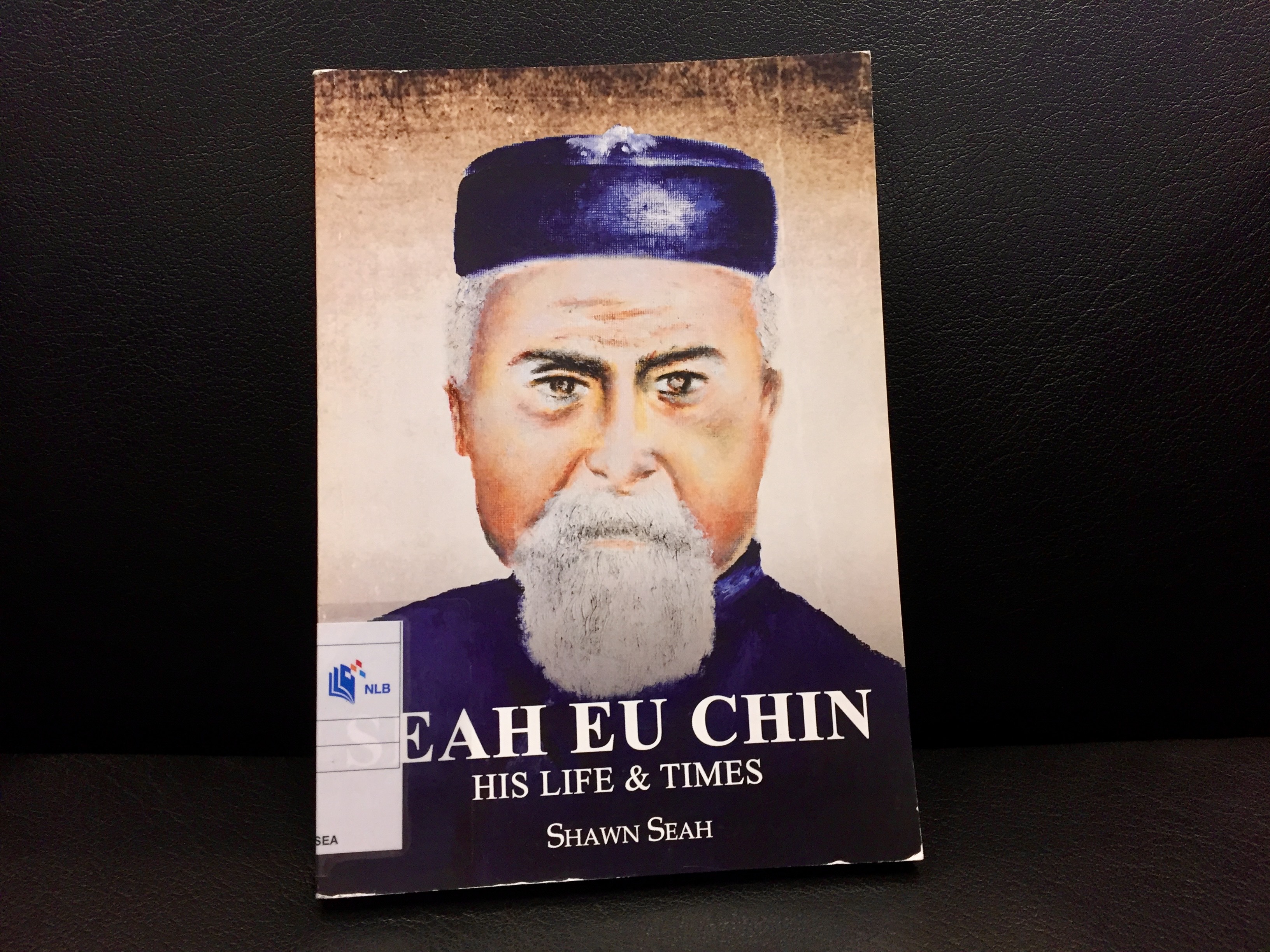
One early and unintended milestone came with my first book, Seah Eu Chin: His Life & Times (1st edition, 2017).

Cover of the first edition of Shawn Seah's book, Seah Eu Chin: His Life and Times.
A copy of the first edition of Seah Eu Chin: His Life and Times. This first edition is out of print, so this photograph was taken at a library. Photograph by author Shawn Seah.

Although it was my first book and my maiden attempt, this self-published book took on a life of its own and crossed Singapore’s border into Malaysia.

(I was writing figuratively: the books were brought across the border by a kind person called Mr Ng.)

As far as I am aware, the now limited first edition book is currently available for sale only at the Johor Bahru Chinese Heritage Museum, located at 42 Jalan Ibrahim, Johor Bahru, Malaysia.

Seah Eu Chin: His Life & Times (2nd Edition, 2019) was subsequently translated into Mandarin, to reach out to Chinese-language audiences.

Cover page of Shawn Seah's book on Seah Eu Chin in Chinese.
Cover of the Chinese translation of Seah Eu Chin: His Life & Times. World Scientific Publishing Company.

This translation has helped introduce Singapore history to some readers in China, creating opportunities for greater cross-cultural understanding and historical appreciation.

I recall one night, several years ago, a lady who shared the same surname as me came to collect copies of this Chinese translation from me, and as far as I understood her Mandarin, the books would be shared with our clanspeople in Yuepu village in China.

My writing has also been featured, referenced, and mentioned in overseas Chinese media platforms, including Sin Chew Daily (星洲网), a Malaysian Chinese-language newspaper; Sohu.com (搜狐网), a Chinese news and media portal headquartered in Beijing; and Guancha (观察者网), a Shanghai-based online news and aggregator site.

In Malaysia, content creator Denise Lee featured my work in her thoughtful article, “Preserving History with Shawn Seah”, published on 1 September 2020 in THEMISSNISE. She reflected on the importance of history and how stories of pioneers like my ancestor Seah Eu Chin continue to shape the way we understand identity and community today. I was very grateful for her generous feature.

In fact, my book on Seah Eu Chin went beyond Asia. I was delighted when UK-based historian Stan Neal cited my research in his chapter, “Mediators, migrants and memories of colonial Singapore: the life and legacy of Seah Eu Chin”. This chapter appears in Singapore – Two Hundred Years of the Lion City (Oxford: Routledge, 2020), edited by Anthony Webster and Nicholas J. White.

Being explicitly referenced and mentioned in a scholarly publication alongside respected historians has been amazing.

These experiences remind me that heritage storytelling has international reach.

One broader point I’d like to make is that Singaporean writers who write exclusively about Singapore should not feel that their work is any less important than the work of people who write for a broader, wider readership.

Jewel, Changi Airport, from a photograph taken by Shawn Seah
Travelling internationally? Think Changi Airport, Singapore! Photograph by author Shawn Seah.

Whether in the pages of a Chinese-language newspaper, a British academic text, or a heritage museum in Malaysia, Singapore’s stories can still spark interest, invite reflection, and build bridges across borders.

To fellow writers wondering whether your words will travel: keep going.

The world may be open to reading your stories and learning more.

Thank you for reading.

Cheers,
Shawn Seah

My Visit to Battlebox Singapore and Our Amazing Heroes

I’m absolutely thrilled to announce that Our Amazing Heroes is now available at Battlebox Singapore!

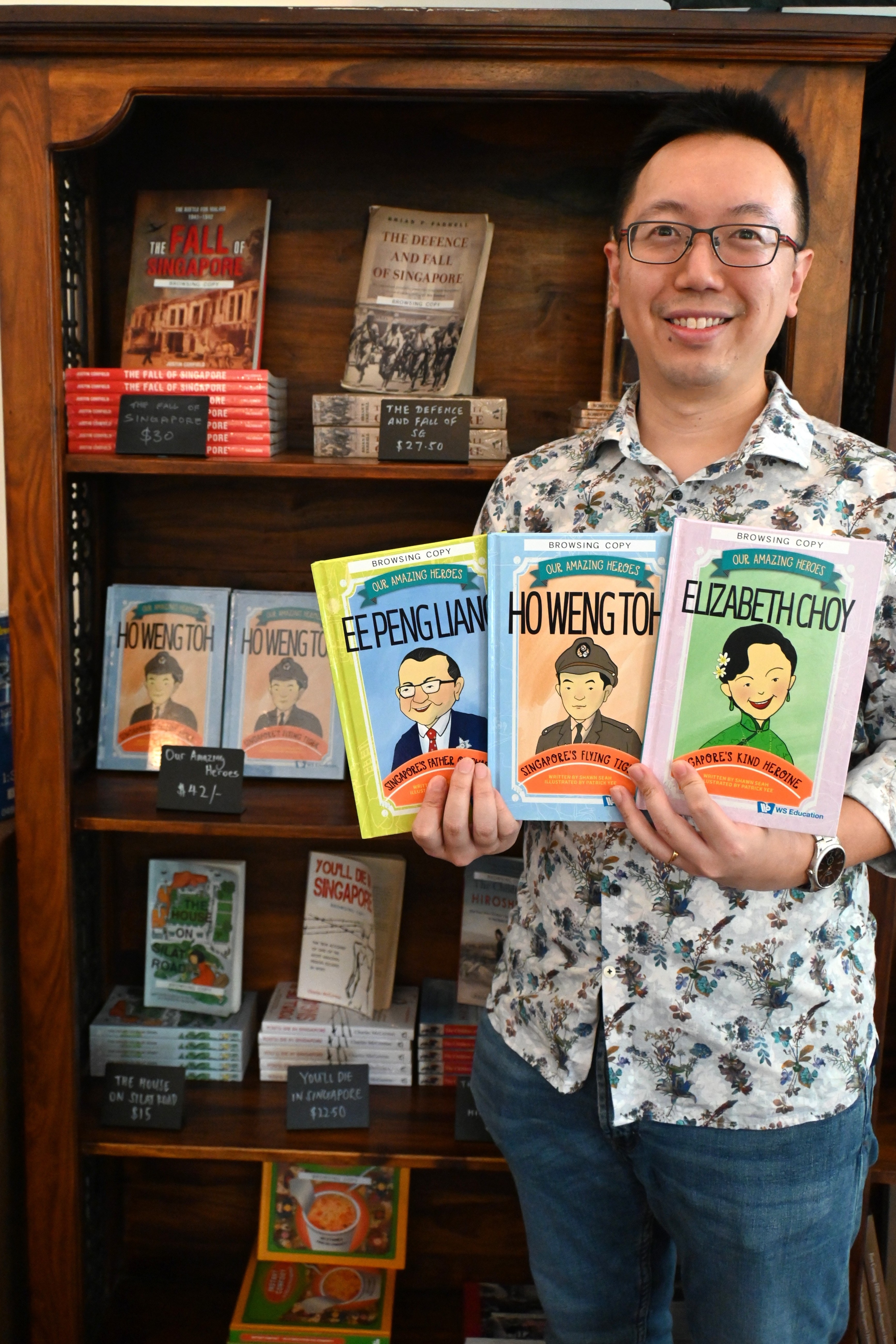
Author and speaker Shawn Seah with his children's book series, Our Amazing Heroes, at the Battlebox Singapore shop.
Author Shawn Seah with his children’s book series, Our Amazing Heroes, at Battlebox Singapore. Photograph by Shawn’s team.

My children’s book series celebrates several Singapore’s heroes who showed enduring values of strength, courage, and compassion during the Second World War: Ee Peng Liang, Captain Ho Weng Toh, and Mrs Elizabeth Choy. These books are available at the Battlebox Singapore shop.

After visiting the shop to shoot my books (pun not intended), I visited the World War II bunker, a few steps away from the main shop.

This visit to Battlebox Singapore was definitely very meaningful; I am sure many history buffs will appreciate it too.

Stepping into the bunker feels like going back in time. Sure, the colonial masters are gone, along with their plans and political intrigue, leaving behind their escape ladder for officers, separate toilets for non-officers, and empty (and somewhat chilling) rooms.

But a 21st century visitor can still imagine and ‘experience’ what it would have felt like.

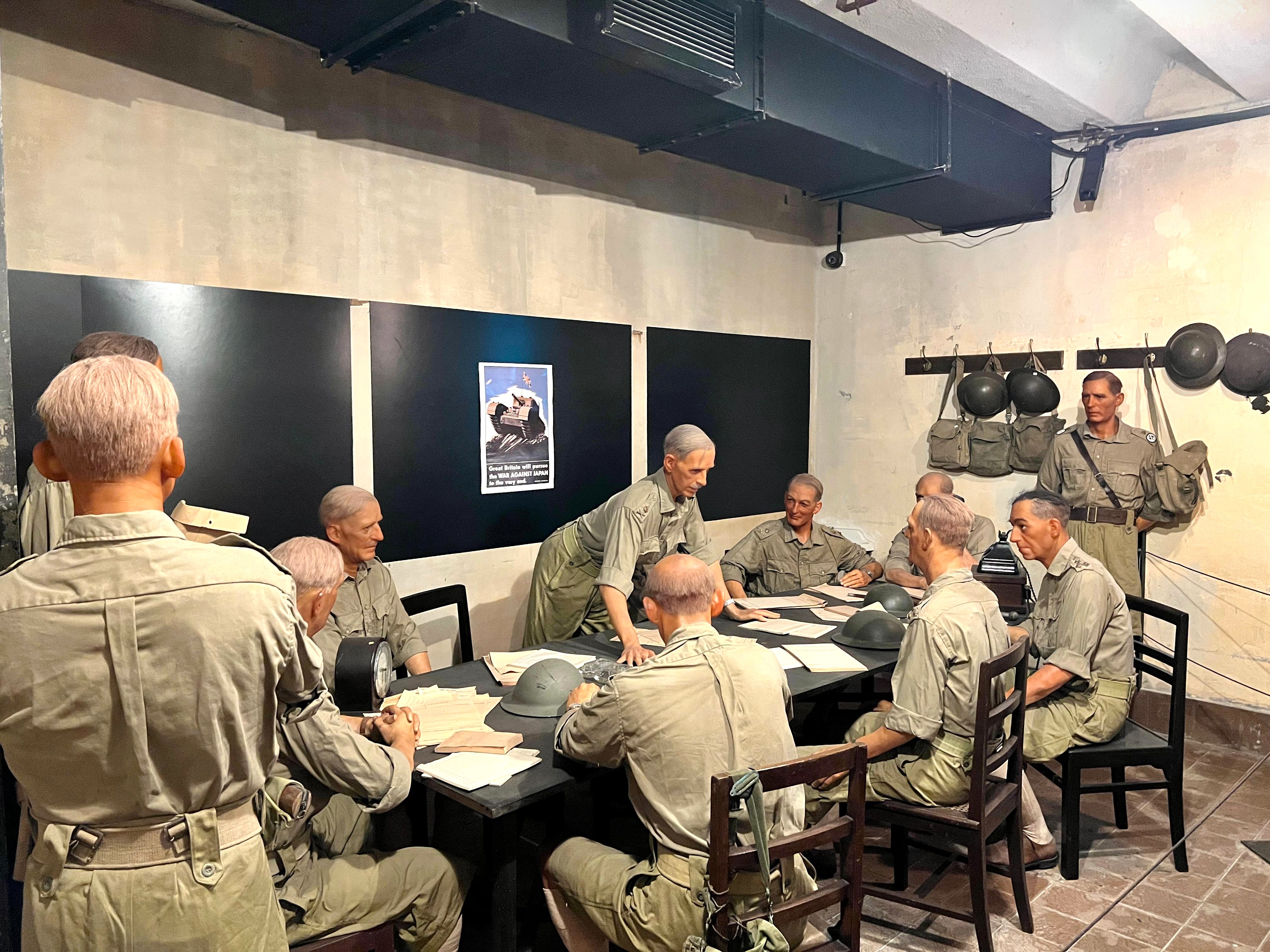
Scene depicting the conference room where Lt General Arthur Percival made the decision to surrender to the invading Japanese forces.
Scene depicting the conference room where Lt General Arthur Percival made the decision to surrender to the invading Japanese forces. Photograph by Shawn’s team.

While admission is free (operator Global Cultural Alliance publicly stated that the site would be freely available and easily accessible to the public), visitors who pay can undergo an enhanced experience that includes an audio guide and anaglyph (red/blue) glasses.

This enhanced experience will bring history to life by allowing people to be involved in the scenes, for example, using the anaglyph glasses to compare between Japanese and Allied perspectives of the battle right before the surrender.

Immersive experience at the Battlebox Singapore.
Visitors can use anaglyph glasses for an enhanced experience. Photograph by Shawn’s team.

Battlebox Singapore is more than just about tunnels and wax figures, or old rooms and modern Virtual Reality and immersive technology (although I hasten to add that I liked the projections of scenes comparing the day before to the day after Singapore’s fall).

Scene at the Battlebox Singapore.
Scene at one of the rooms at Battlebox Singapore. Photograph by Shawn’s team.

This place carries an important, larger, national message, one that bears repeating in this SG60 year, as we mark 60 years of Singapore’s independence.

Hidden beneath Fort Canning Hill, this underground command centre reminds us that we Singaporeans must be ready to defend our island home ourselves.

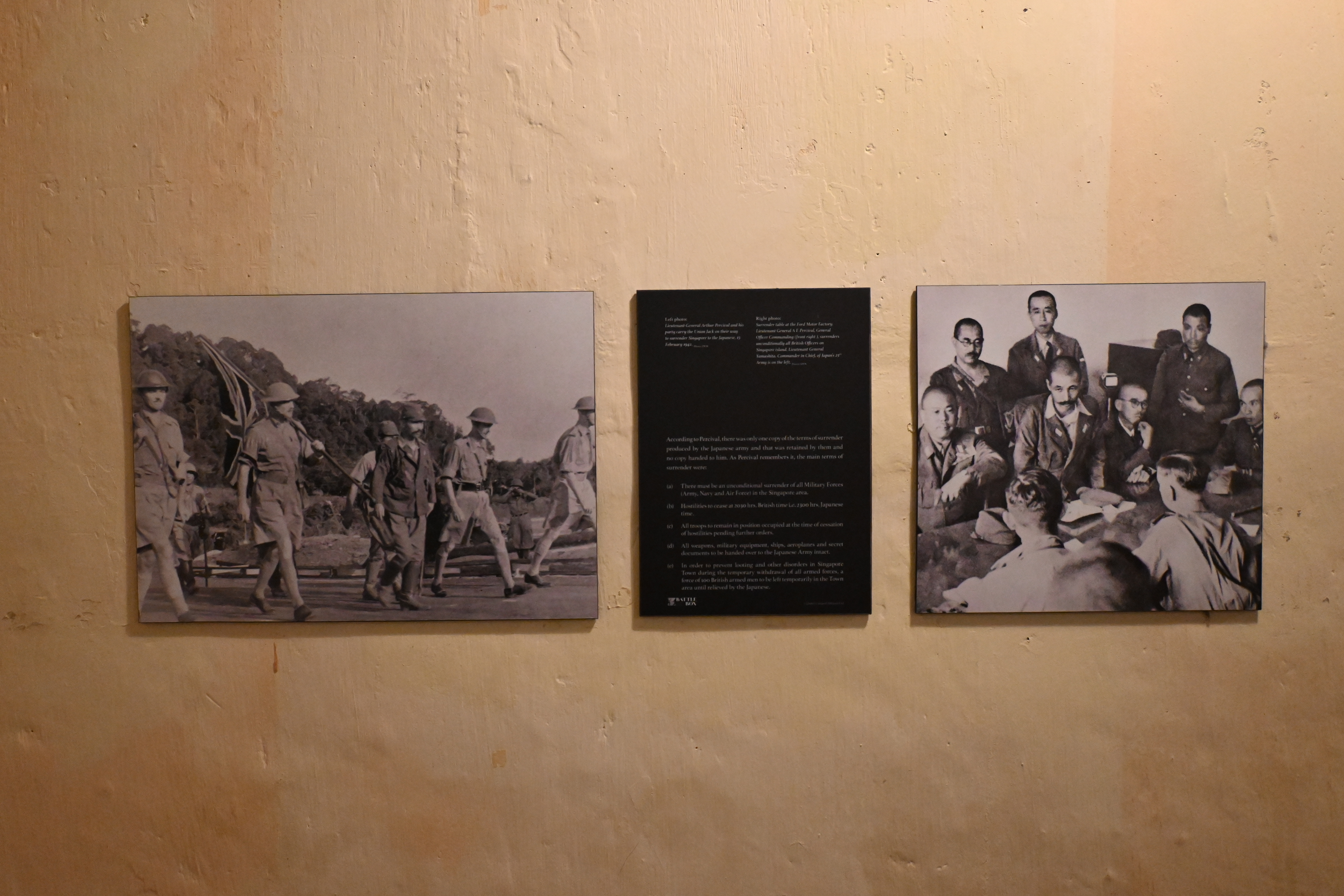
Pictures of the British surrender during World War II.
These are arguably the two most famous photographs of (i) Lt General Percival and the British military leaders walking up the driveway of the Ford Motor Factory on the day of the surrender and (ii) the British surrender at the conference room of the Ford Motor Factory. Photograph by Shawn’s team.

After all, it was here that the British military leaders decided to surrender Singapore to the invading Imperial Japanese forces on 15 February 1942.

This surrender meant the beginning of many years of hardship, hunger, and suffering during the Japanese Occupation. But it also meant that this was the first time that our forefathers resolved that we could never again leave our fate to the hands of others, and we must determine our own future.

Author Shawn Seah's Elizabeth Choy: Singapore's Kind Heroine and Ho Weng Toh: Singapore's Flying Tiger on a store shelf at Battlebox Singapore.
Our Amazing Heroes on display and next to Secrets of the Battlebox. Photograph by Shawn’s team.

If you are visiting this iconic heritage site, do remember to pick up copies of Our Amazing Heroes and bring these stories of heroism home!

Thank you for reading and your kind support.

Cheers,
Shawn Seah

How to Give an Amazing Assembly Talk!

School assemblies are an important part of pupils’ lives.

They are a shared community experience where the whole school comes together, to start the day or mark a special occasion, like 60 years of Singapore’s independence (SG60) or a school’s anniversary.

Author and speaker Shawn Seah speaking at an assembly talk at Ngee Ann Primary.
Author Shawn Seah speaking at Ngee Ann Primary School during an assembly talk. Photograph by Shawn’s team.

Speaking at a school assembly is an honour and a privilege.

You are responsible for engaging the entire school as well as teachers who are standing or sitting by the side of the school hall.

The heads of department, teachers, or librarians who invited you have entrusted you with this (sacred) duty.

All eyes are on you, and for that 20, 25, or even 30 minutes, you hold court.

A school assembly talk should be energetic, engaging, and exciting for the children. Or, as I like to put it, “edu-taining”.

When done well, a talk can stay with children long after the bell rings.

Here are some of my personal reflections and best practices, drawn from my experiences and mistakes of speaking to children aged seven to twelve at school assemblies across Singapore. They remind me of what worked well, and hopefully you might find some of these pointers useful too.

Author and speaker Shawn Seah at an assembly talk at Ngee Ann Primary.
Author and speaker Shawn Seah introducing his children’s book series, Our Amazing Heroes. Photograph by Shawn’s team.

Have a lot of positive energy!

You have to begin with a lot of energy and a positive attitude to engage the students!

Come in with good posture, a bright presence, and a can-do spirit.

Let your enthusiasm show from the moment you step onto the stage.

Smile widely and think happy thoughts!

A big wide smile shows that you are friendly, confident, and approachable. It sets the tone.

Best of all, smiles are contagious. If you smile, they smile back.

I am often reminded of what Dale Carnegie once wrote about magician Howard Thurston in How to Win Friends and Influence People.

Each time Thurston went up on stage to perform, he said to himself: “I am grateful because these people come to see me. They make it possible for me to make my living in a very agreeable way. I’m going to give them the very best I possibly can.”

Thurston was grateful for his audience’s support.

And I am sure they loved and respected him back.

These are words of enduring wisdom that I try to live by.

Whether it is for a magic performance, a keynote address for adults, or an assembly talk for primary school pupils, these are truly words of wisdom.

Show of hands!

One of the best ways to start your assembly talk is with a quick poll.

“Hands up if you’ve heard of Tan Tock Seng!”

“Who wants to be a time traveller? Raise your hands!”

“Who’s excited to hear stories today? Quick show of hands!”

These questions invite children to respond, think, and compare their answers with their friends. You create immediate interaction. The hall comes alive.

Polling students is fun!

Are… youuuuu… ready?!!!

I also like to dramatically point the microphone at my audience and rally them, “Are you ready to hear some stories?”

Then I pause. “I can’t hear you!” or “That’s not loud enough!”

And again, I shout, louder: “You can do better than that!”

This call-and-response builds excitement and children love the playful energy.

Use strong images, not just words, on your slides

Children respond well to colourful, large, and vivid pictures.

A slide with a striking photo or bold illustration draws attention.

Images can evoke wonder. They spark questions.

Involve them early and often

I typically ask questions throughout my storytelling session.

“What do you think happened next?”

“If you were there, what would you have done?”

“Do you think they lived happily ever after?”

These questions invite children into the narrative.

Let them wonder, guess, and imagine.

Use familiar words and concrete examples

Speak plainly.

Use clear, everyday language.

Avoid jargon or complicated expressions.

Children understand best when you paint a scene they can imagine.

Describe the sights, sounds, and smells.

Tell them about the muddy ground, the noisy ship, the bright lanterns.

The more concrete your examples, the more they remember.

And they can remember details.

Author and speaker Shawn Seah is giving an assembly talk at a primary school.
Author and speaker Shawn Seah giving an assembly talk. Photograph by Shawn’s team.

Remember, this is performance art

An assembly talk is not just an ordinary talk. It is a performance.

In fact, it is closer to a one-person play.

Your voice needs to carry across the hall.

Project your voice. Vary your tone. Use dramatic pauses.

Let your face and hands do some of the talking too.

Move around the stage.

Make eye contact with different parts of the audience.

Sometimes, I dramatically walk among the children to make a point. It surprises them and draws them in.

Repeat, repeat, repeat

Children learn through repetition, repetition, repetition.

If there is one key word, phrase, or idea you want them to take away, repeat it many, many, many times throughout your talk. Naturally, you can use rhythm, rhyme, and alliteration to make repeated lines memorable.

Repetition works.

Repetition reinforces.

Repetition sticks.

Frame things from the children’s perspective

An assembly talk is for the children, so it makes perfect sense to frame things from their perspective, so that they can better enjoy the talk.

Try to put the pupils into the shoes of the people you are speaking about.

“Imagine you were hiding in a rubber plantation during the Second World War. What would that feel like?”

“Imagine you were on the ship with Pillai. What would it be like?”

“What would you have done if you were there?”

Let them feel the story.

When children relate personally, they remember more.

Give them room to imagine what they would do or how they would feel.

Always connect what you are saying to the present

I try my best to help them see how the stories matter today.

I try to connect the values and lessons from the past to their own lives.

Maybe you are sharing a story about kindness, resilience, or courage. Remind them that these are good values they can show today, in school, at home, or with their friends.

But forgive yourself when things don’t go as planned

I have spoken to many, many groups of people, and children are an especially tough crowd.

Not everything will go perfectly.

Sometimes the tech does not work well. The microphone shrieks. The children are sleepy and not in the mood to cooperate with you.

Don’t worry. My advice: forgive yourself.

Bear in mind that this is the biggest mixed-ability and mixed-preference class that you will face. Some are sleepy, some hungry, some bursting with energy. Some are listeners, others readers, and yet others are read-write types.

Just do your best. Speak from the heart. And if things do not go perfectly, that is life. Forgive yourself and do not be too hard on yourself.

Author and speaker Shawn Seah signing books for primary school pupils.
Students catching up with their favourite author! Photographs by Shawn’s team.

Just remember that assembly talks are not just moments to deliver a message (only).

They are moments to inspire.

When that connection happens, when children look up at you and have a sense of wonderment on their faces, or ask you many strange and weird questions after that, you know it was all worth it.

Thank you for reading.

Cheers,
Shawn Seah

Note: This is a longer and more detailed piece based on a story I previously posted on Medium.

Fact Attack at the Singapore Children’s Book Festival (SCBF) 2025!  

I enjoyed moderating a panel discussion called “Fact Attack! Making Non-Fiction Fun and Fascinating” at SCBF 2025!

It was an honour to take part in the SCBF for the first time, during its second edition.

The whole idea of my panel was that non-fiction books did not have to be dry and dull. As I personally believe in edutaining children and making history come alive, I readily agreed to be part of the panel.

Author and speaker Shawn Seah, Ng Yi Sheng, and David Liew at a panel discussion at SCBF 2025.
From left to right, Ng Yi-Sheng, Shawn Seah, and David Liew during a panel discussion. Photograph by Shawn’s team.

My fellow panellists were award-winning author Ng Yi-Sheng and talented illustrator and crafter David Liew (according to him, sometimes confused with award-winning children’s book author David Seow).

And Yi-Sheng even brought Mr Monyet along, a monkey puppet. I hasten to add that this was the first time I had ever had a puppet attend any of my talks.

The three of us (and the monkey) talked about our love of history; the uses of humour; writing on problematic parts of history for children, like opium and war; parents’ concerns on how facts were portrayed; the limits of artistic licence; how facts ought to be conveyed to children; as well as how to scope stories to young children.

Author and speaker Shawn Seah standing with Ng Yi Sheng and David Liew, as well as a monkey puppet, during SCBF 2025.
From left to right, Mr Monyet (the monkey puppet), Ng Yi-Sheng, David Liew, and Shawn Seah at the SCBF 2025. Photograph by Shawn’s team.

It was really an engaging experience!

Being part of a festival dedicated to books for children feels amazing, just like when I was speaking at the Asian Festival of Children’s Content (AFCC). I appreciated the fact that SCBF 2025 was more than just a celebration of fiction, but non-fiction children’s books as well, just like AFCC 2025.

I have actually moderated many panels over the years, like a panel during the Baba Nyonya Literary Festival 2022 and the NTUC Career Festival 2025. But this one was easily the funniest and most humorous panel I have had the privilege of moderating.

I was glad that we shared laughter, learning, and maybe a little inspiration with our audience too.

Thank you to the Singapore Book Publishers Association and Nanyang Academy of Fine Arts, University of the Arts Singapore, the organisers of the SCBF, for inviting me to be part of this amazing festival. And I look forward to being called back again!

Thank you for reading.

Cheers,
Shawn Seah